Your greeting is the first thing a reader sees. It sets the tone before they read a single idea.
On a phone, the first line of your email may also show as preview text. That means your opening words work twice.
How many people read on mobile? It depends on the report. A 2025 roundup from Saleshandy, citing MailerLite benchmarks, puts mobile at 41.6% of opens. Other 2025 reports put it above 55%. Either way, a big share of your readers see a small screen first.
The right choice from the many professional email greetings depends on four things:
- The recipient
- Your relationship with them
- The purpose of the email
- The level of formality
A good greeting works best with a clear subject line, correct name spelling and a business-domain email address.
This guide covers 15 greetings. You will see when to use each one, real examples, and how to adapt them for clients, colleagues, suppliers, job applications and cold outreach.
How to choose the right email greeting
Start with the table below. It matches common situations to the greeting that fits best.
| Situation | Best greeting | Example |
|---|---|---|
| Formal first contact | Dear [Full Name], | Dear Sarah Nabukenya, |
| Senior official, doctor, professor | Dear [Title] [Last Name], | Dear Dr. Mugisha, |
| New client or supplier | Hello [Full Name], | Hello David Okello, |
| Existing client or colleague | Hi [First Name], | Hi Grace, |
| Same-day meeting or update | Good morning/afternoon [Name], | Good morning Aisha, |
| Team or department | Hi team / Hello [Department] Team, | Hello Accounts Team, |
| Unknown recipient | Hello / Hello [Department] Team, | Hello Support Team, |
| Follow-up | Hi [Name], following up on… | Hi Peter, following up on our quotation. |
When in doubt, go one step more formal. You can always relax the tone in your next message.
Now let’s look at each greeting in detail.
15 professional email greetings to use
Each greeting below shows what it is, where it fits, and what to avoid. You will also see how to adapt it for cold emails.
1) Dear [Full Name],
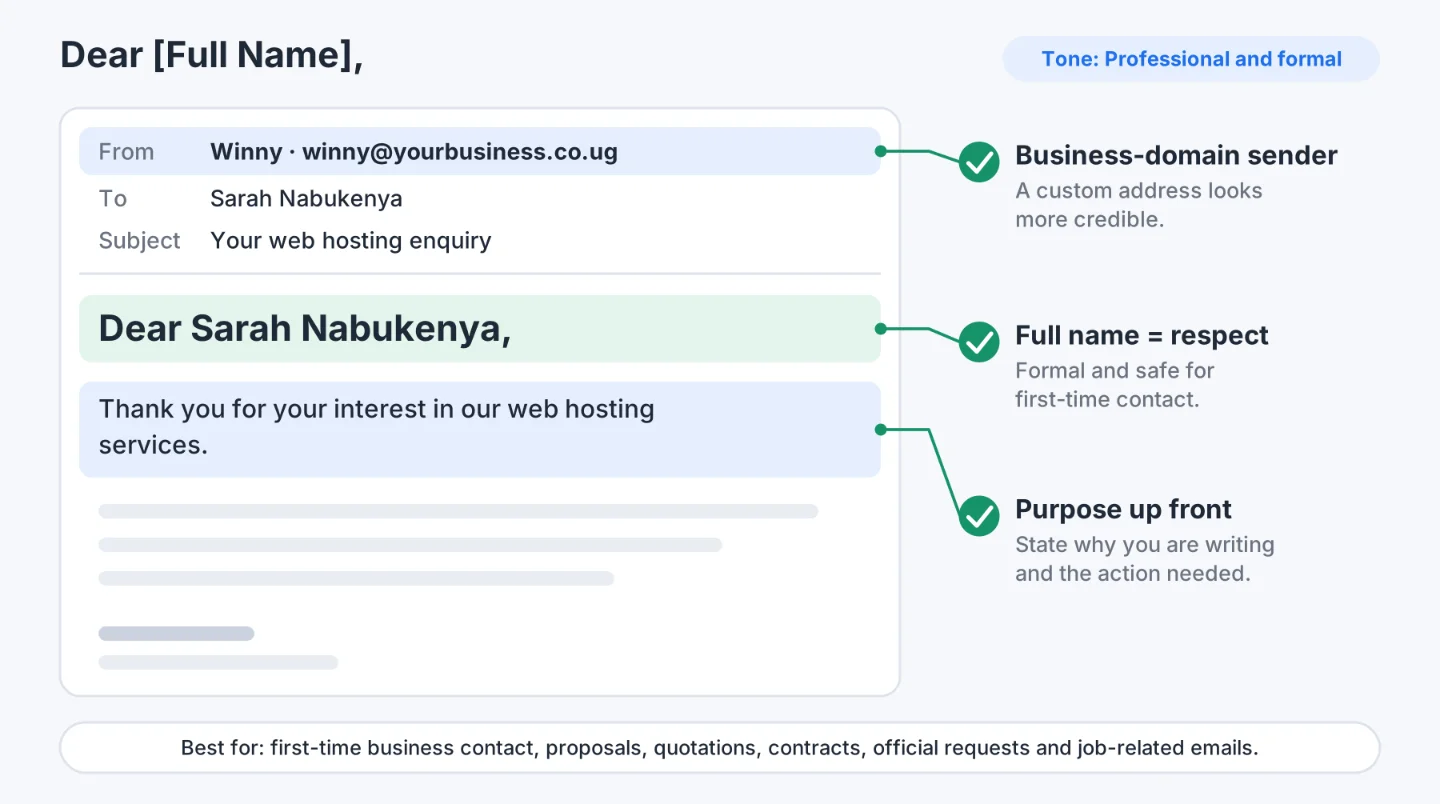
- What it is: A formal, respectful greeting using the recipient’s complete name.
- Best for: First-time business contact, proposals, quotations, contracts, official requests, and job-related emails.
- Tone: Professional and formal.
- Example: “Dear Sarah Nabukenya, thank you for your interest in our web hosting services.”
- Cold-email variation: Use for senior contacts or high-value business opportunities.
- Avoid: Using it for close colleagues or regular clients.
- What to write next: State the purpose of the email and the action required.
It is the safest starting point when you are unsure.
2) Dear [Title] [Last Name],
- What it is: A respectful greeting that includes the recipient’s professional, academic, religious, or official title.
- Best for: Doctors, professors, religious leaders, senior officials, and highly qualified professionals.
- Tone: Very formal and respectful.
- Example: “Dear Dr. Mugisha, we would like to invite your clinic to participate in our upcoming digital-health campaign.”
- Cold-email variation: Use when contacting a senior decision-maker with a relevant proposal.
- Avoid: Guessing a title. Use “Dear [Full Name],” if unsure.
- What to write next: Briefly introduce yourself and explain why you are writing.
A wrong title can hurt more than no title.
3) Dear [First Name],
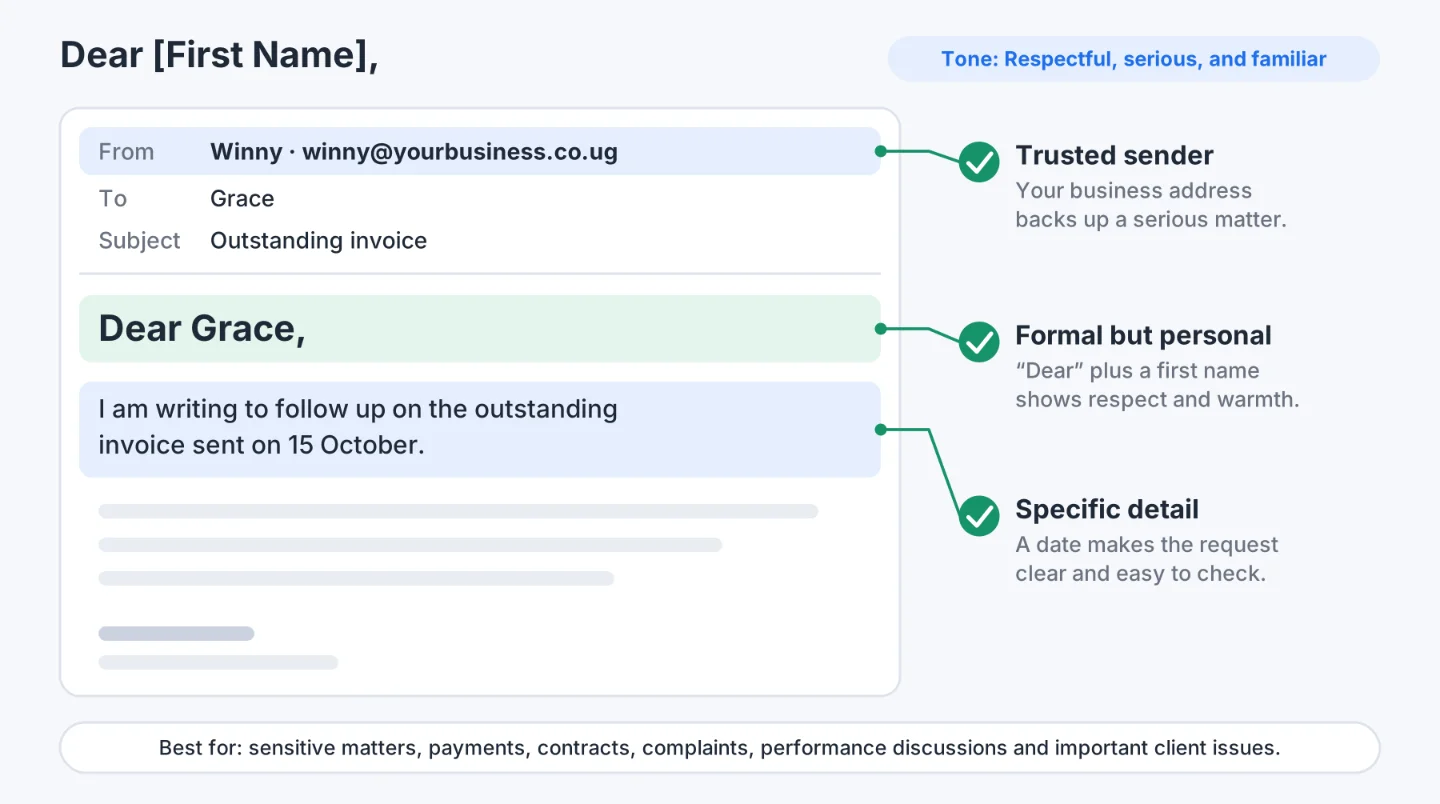
- What it is: A formal but personal greeting for someone you already know.
- Best for: Sensitive matters, payments, contracts, complaints, performance discussions, and important client issues.
- Tone: Respectful, serious, and familiar.
- Example: “Dear Grace, I am writing to follow up on the outstanding invoice sent on 15 October.”
- Cold-email variation: Generally avoid. Use “Dear [Full Name],” or “Hello [Full Name],” instead.
- Avoid: Using it for senior contacts you have never emailed.
- What to write next: Acknowledge the relationship or previous conversation, then explain the main point.
It shows you take the matter seriously, without sounding cold.
4) Dear Hiring Manager,
- What it is: A neutral professional greeting used when the recruiter’s name is unknown.
- Best for: Job applications, cover letters, and follow-up emails after an interview.
- Tone: Formal and professional.
- Example: “Dear Hiring Manager, I am writing to apply for the Administrative Assistant position advertised on your careers page.”
- Cold-email variation: Use when contacting HR about possible openings.
- Avoid: Using it when the recipient’s name is available.
- What to write next: Mention the role, where you found it, and why you are a strong fit.
A quick check of the company website or LinkedIn page often finds the name.
5) Dear [Job Title],
- What it is: A professional greeting addressed to a role rather than a named person.
- Best for: Partnership requests, supplier inquiries, tenders, sponsorships, and B2B outreach.
- Tone: Formal and businesslike.
- Example: “Dear Procurement Manager, we would like to submit a quotation for the office internet packages discussed in your request.”
- Cold-email variation: Use when targeting a department or role within an organization.
- Avoid: Vague titles such as “Dear Manager” when a specific title is available.
- What to write next: Clearly state the opportunity, problem, or request.
Be specific. A precise title shows you did your homework.
6) Hello [Full Name],
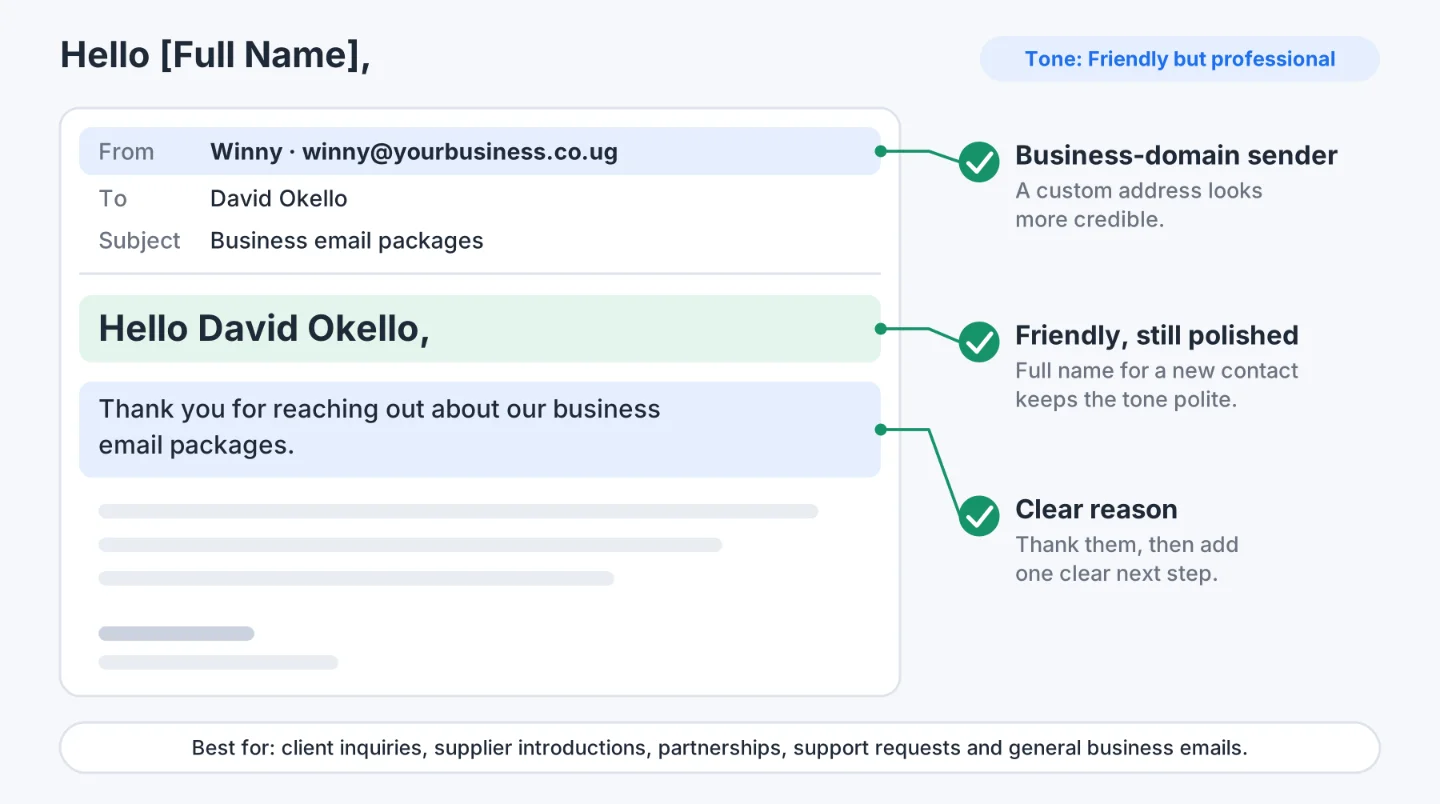
- What it is: A flexible professional greeting for a new contact whose name you know.
- Best for: Client inquiries, supplier introductions, partnerships, support requests, and general business emails.
- Tone: Friendly but professional.
- Example: “Hello David Okello, thank you for reaching out about our business email packages.”
- Cold-email variation: Use when you want to sound approachable rather than overly formal.
- Avoid: Using it for highly formal legal, academic, or government correspondence.
- What to write next: Explain why you are contacting them and include a clear next step.
It works well when you do not know someone’s title or preferred name style.
7) Hi [First Name],
- What it is: A friendly, direct greeting for people you already know.
- Best for: Colleagues, existing clients, suppliers, meeting updates, project discussions, and customer-service replies.
- Tone: Casual-professional.
- Example: “Hi Janet, I am following up on the delivery schedule for last week’s order.”
- Cold-email variation: Use only with a genuine reason, such as a referral or prior interaction.
- Avoid: Using it for senior contacts or first-time formal communication.
- What to write next: Go straight to the purpose and make your request easy to answer.
This is the everyday greeting for most working relationships.
8) Good morning/afternoon [Name],
- What it is: A time-based greeting used when timing is relevant.
- Best for: Meeting confirmations, same-day follow-ups, appointment reminders, and messages sent during working hours.
- Tone: Warm and professional.
- Example: “Good morning Aisha, confirming our meeting at 10:00 a.m. today.”
- Cold-email variation: Use sparingly. Pair it with a clear reason for reaching out.
- Avoid: “Good evening” unless you are sure the recipient will read the email then.
- What to write next: Confirm the time-sensitive point or move directly into the main message.
Remember that people read emails at different hours. A time-based greeting can feel wrong if the message sits unread.
9) Hey [First Name],
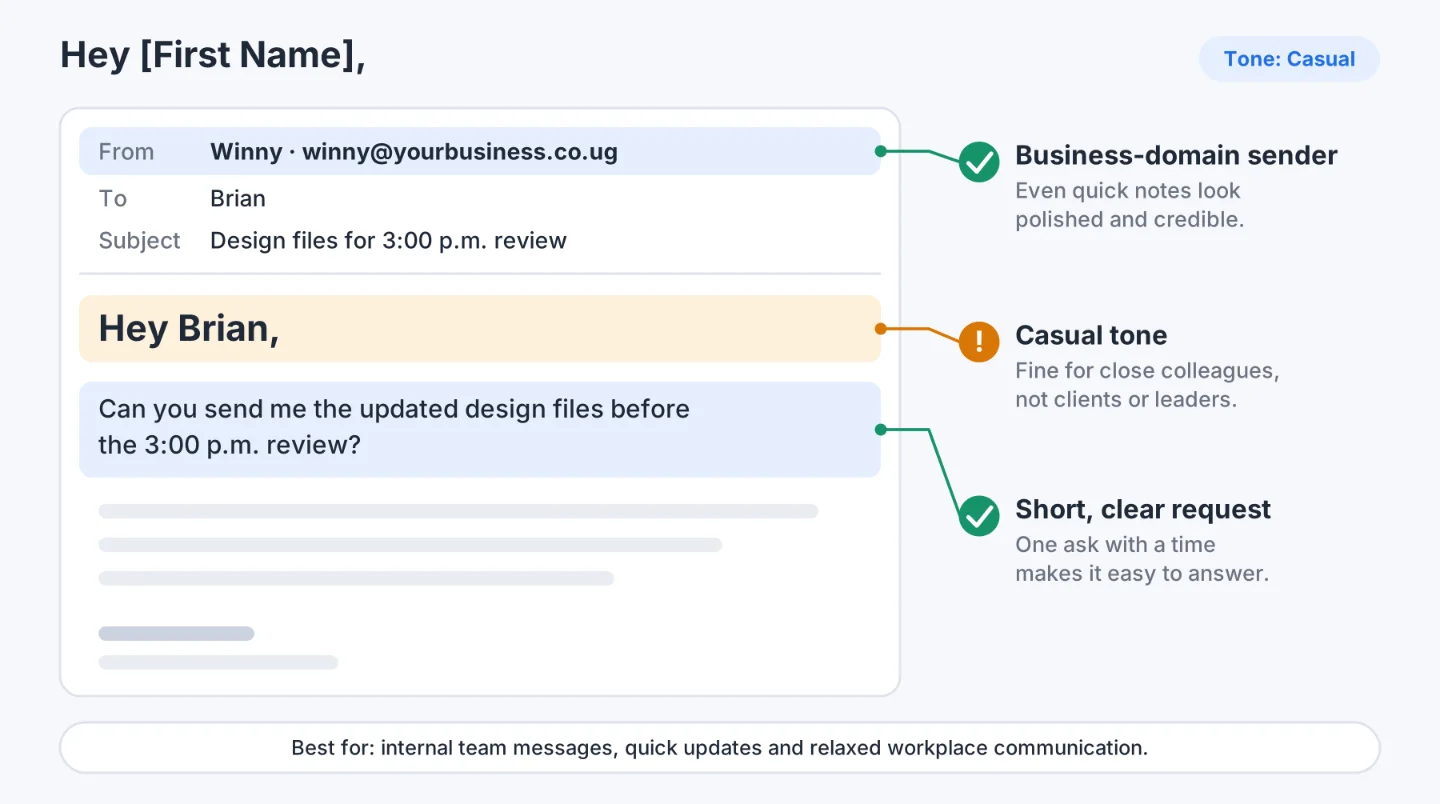
- What it is: An informal greeting for close colleagues or familiar contacts.
- Best for: Internal team messages, quick updates, and relaxed workplace communication.
- Tone: Casual.
- Example: “Hey Brian, can you send me the updated design files before the 3:00 p.m. review?”
- Cold-email variation: Avoid. It can appear unprofessional in first-time outreach.
- Avoid: Clients, senior leaders, government offices, and formal business contacts.
- What to write next: Keep the message brief and match the casual tone.
Use it only where the culture supports it.
10) [First Name],
- What it is: A direct, non-formal greeting using only the recipient’s first name.
- Best for: Short internal messages to colleagues you know well.
- Tone: Direct and informal.
- Example: “Brian, the client has requested a revised invoice. Can you update it today?”
- Cold-email variation: Avoid. It may feel abrupt or mass-sent.
- Avoid: External clients, senior contacts, and formal communication.
- What to write next: State the request immediately and keep the email short.
Think of it as a quick tap on the shoulder.
11) Hi [Name] and [Name],
- What it is: A greeting for two or three named recipients.
- Best for: Project updates, joint client communication, meeting follow-ups, and interdepartmental coordination.
- Tone: Professional and inclusive.
- Example: “Hi Grace and Daniel, thank you for joining today’s planning call.”
- Cold-email variation: Use when contacting two known decision-makers.
- Avoid: Listing too many names.
- What to write next: Clarify who needs to act and what the next step is.
Naming people makes each one feel responsible for a reply.
12) Hello everyone / Hi everyone,
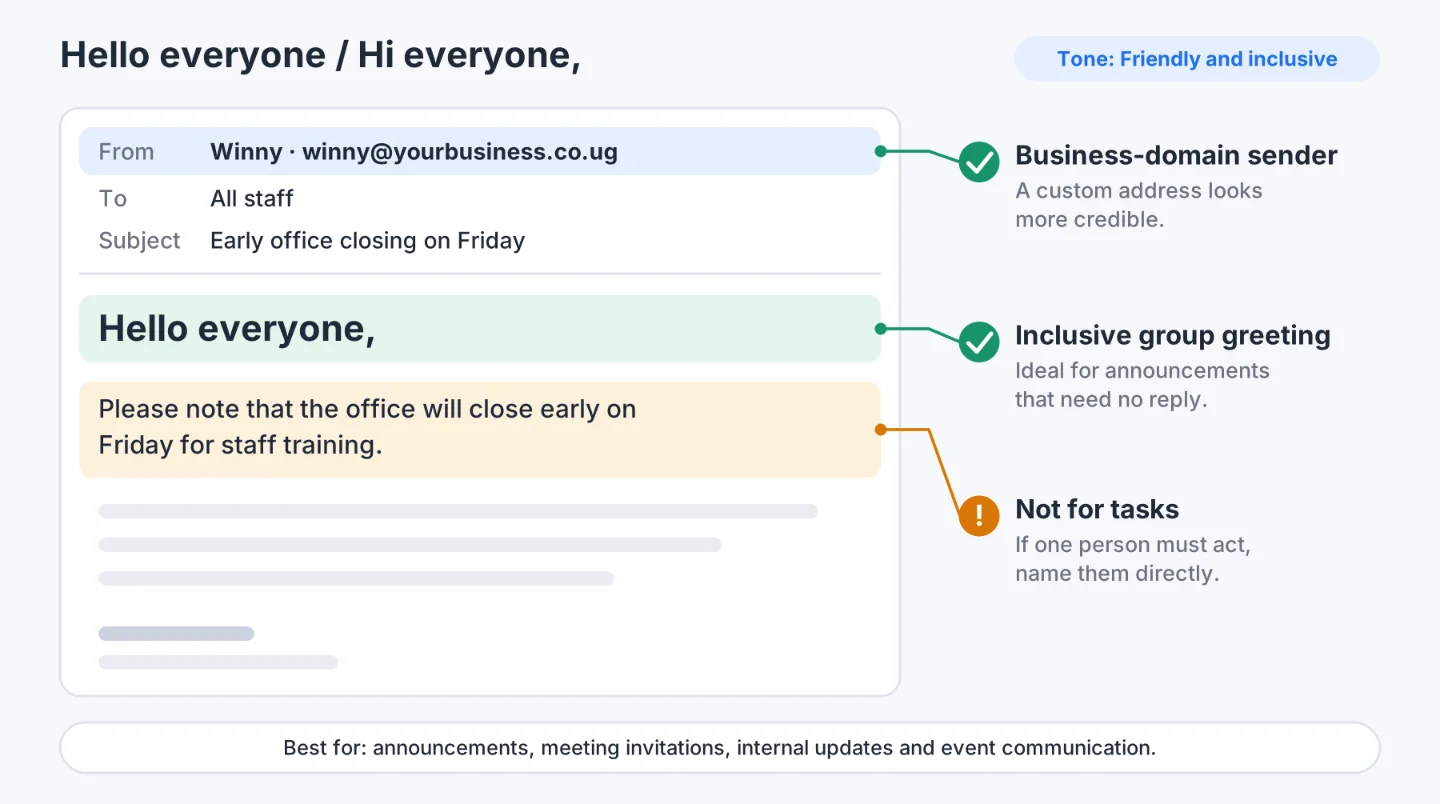
- What it is: A group greeting for recipients who do not need to be addressed individually.
- Best for: Announcements, meeting invitations, internal updates, and event communication.
- Tone: Friendly and inclusive.
- Example: “Hello everyone, please note that the office will close early on Friday for staff training.”
- Cold-email variation: Avoid. It signals a mass email.
- Avoid: Using it when only one or two people need to act.
- What to write next: State the announcement, deadline, or required action.
Group greetings suit news. They do not suit tasks.
13) Hi team / Hello team,
- What it is: A warm internal greeting for a team you work with regularly.
- Best for: Project updates, task assignments, meeting reminders, and team announcements.
- Tone: Casual-professional.
- Example: “Hi team, the client has approved the revised homepage design.”
- Cold-email variation: Avoid unless writing to a small internal group with clear context.
- Avoid: Using it when a specific person needs to respond.
- What to write next: Assign task owners and include deadlines.
If nobody is named, nobody feels responsible. Add names in the body.
14) Hello [Department] Team,
- What it is: A professional greeting for a department inbox or team responsible for a function.
- Best for: Customer support, accounts, HR, procurement, supplier inquiries, and partnership requests.
- Tone: Professional and clear.
- Example: “Hello Support Team, I need assistance configuring my business email account on Outlook.”
- Cold-email variation: Use when targeting a department rather than an individual.
- Avoid: Using it when you know the name of the responsible person.
- What to write next: Describe the issue or request and state the response you need.
If your own business runs shared inboxes, such as [email protected], a custom domain keeps them consistent. You can set up business email with us at Truehost for each department.
Busy teams can also sort incoming messages by department using automation. We at Truehost offer n8n hosting and AI Workers for that kind of routine work. A person should still review anything before it goes out.
15) Hi again [Name],
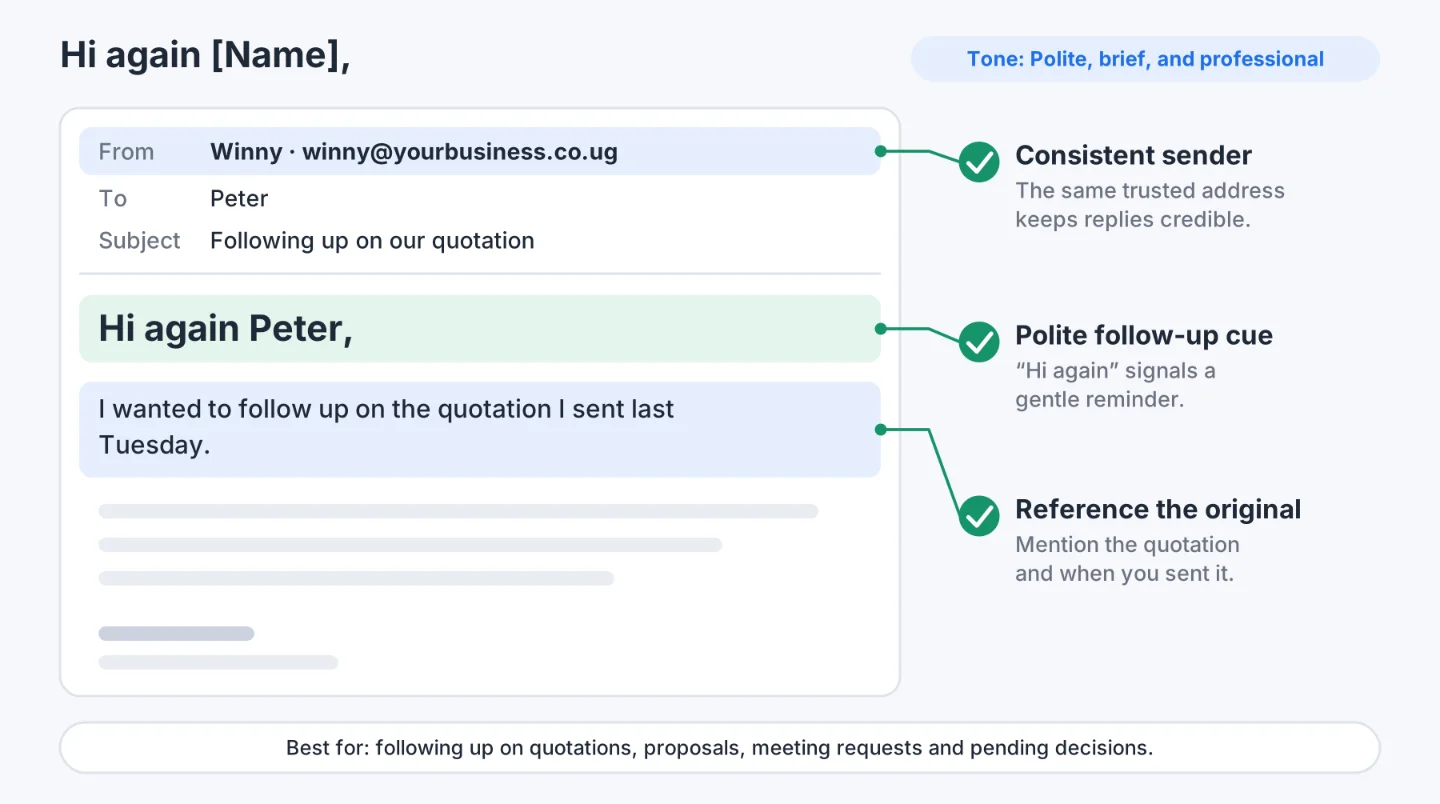
- What it is: A polite follow-up greeting after a previous unanswered email.
- Best for: Following up on quotations, proposals, meeting requests, and pending decisions.
- Tone: Polite, brief, and professional.
- Example: “Hi again Peter, I wanted to follow up on the quotation I sent last Tuesday.”
- Cold-email variation: Use for a second or third follow-up, not the first message.
- Avoid: Repeating it too many times without a response.
- What to write next: Restate the value, add a new reason to reply, and include a simple call to action.
Follow-ups are worth the effort. Belkins’ 2026 study, based on more than 7.5 million emails, found that follow-ups account for 58.6% of all replies in a sequence.
The same study found that the first email in a sequence has the highest per-step reply rate, at 0.59%. So make the first message count, then follow up politely.
If you send many follow-ups, automation can track them for you. Our VPS, dedicated servers, OpenClaw hosting, AI Workers and n8n hosting plans give teams room to run those workflows. Keep the wording personal, though.
What to write after the greeting
The greeting opens the door. The next line decides whether the reader walks in.
- State the purpose in the first sentence.
- Match the greeting’s tone throughout the email.
- Use short paragraphs and clear language.
- Include one specific request, question, or next step.
- End with a professional closing, name, role, company, phone number, and business email address.
Example: “Hello Ms. Nakato, thank you for your interest in our business email hosting. I have attached the package options and setup steps. Would you like me to schedule a short call?”
Notice how short it is. The purpose, the attachment and the next step all fit in three sentences.
Want your signature to carry a branded address too? Open a business email with us at Truehost.
How to make your email greetings more professional
Small details separate a polished email from a careless one.
- Use the recipient’s correct name and preferred title.
- Check spelling before sending.
- Match the greeting to the relationship and purpose.
- Avoid unfilled placeholders.
- Keep the greeting and opening line short for mobile readers.
- Use a professional signature with your name, role, company, and contact details.
- Send from a business-domain email address, such as [email protected].
That last point makes a real difference. A Verisign survey, cited in an October 2025 article by Tablein, found that 74% of consumers would trust a company-branded email address more than a free one.
The survey itself is older, so treat it as a directional signal rather than a current measure.
The tradeoff is small. A domain and mailbox cost money, and you must set up and manage them. In return, your messages look more credible from the first line.
We at Truehost can help you set this up. See our business email plans.
A professional greeting is only part of a credible business email. With us at Truehost, you can create a custom business email address using your own domain, helping your messages look more trustworthy from the moment they arrive.
Pair the right professional email greetings with an address that matches your brand.
Professional Email Greetings FAQs
Can I use emojis in professional email greetings?
- Use emojis sparingly and only when the relationship and company culture support them.
- Avoid emojis in job applications, legal communication, formal proposals, and first-time contact with senior professionals.
- A simple text greeting is usually the safest option.
Should I use “Ms.,” “Mr.,” or “Mrs.” in an email greeting?
- Use a title only when you are certain it is correct and preferred.
- If unsure, use the recipient’s full name, such as “Dear Sarah Nabukenya,”.
- Avoid assuming marital status. “Ms.” is generally safer than “Mrs.” when a title is necessary.
How do I greet someone whose gender or preferred title I do not know?
- Use their full name: “Dear [Full Name],”.
- Alternatively, use “Hello [Full Name],” for a modern professional tone.
- Avoid gendered assumptions and do not guess titles.
Is it okay to use a greeting in a reply email?
- Yes, especially in the first reply or when the conversation is formal.
- For ongoing email threads, you may reply directly without a greeting if the exchange is short and familiar.
- Use “Hi [First Name],” or “Hello [First Name],” when replying to clients or external contacts.
How soon should I follow up if someone does not reply?
- Wait two to three business days for routine business emails.
- Follow up sooner only if the matter is urgent or time-sensitive.
- Keep the follow-up short, reference the original email, and include one clear request.
Can I use the same greeting for email and WhatsApp business communication?
- Not always. Email usually requires a more formal greeting, especially for first contact.
- WhatsApp can be slightly more conversational, but still professional for client communication.
- Match the platform, relationship, and purpose of the message.
What is the best greeting for an email sent to multiple departments?
- Use “Hello [Department] Team,” when writing to one department.
- Use “Hello everyone,” or “Hi everyone,” for a broad internal group.
- If specific people must act, name them individually or clarify responsibilities in the body.
Should the greeting match the recipient’s culture or language?
- Yes. Use a greeting style that feels respectful and natural within the recipient’s business culture.
- If communicating in a local language is normal for your audience, use it appropriately and professionally.
- When unsure, use clear, neutral English greetings such as “Dear [Full Name],” or “Hello [Full Name],”.
