Found a domain that fits your brand, but someone else owns it?
Domain negotiation is how you get it without overpaying.
Done well, it protects your budget and secures a name that supports your brand. Done badly, it hands the seller all the power.
Prices swing wildly. NameBio data shows the 2024 aftermarket recorded about 144,700 sales worth $185 million, at an average of $1,281 per sale (as summarised by DomainDetails).
A few huge sales pull that average up, so most names sell for far less.
This guide helps you understand the domain’s value, assess the seller, negotiate strategically, and close safely.
The process looks like this:
- Research
- Contact
- Negotiate
- Close
- Walk away if necessary
Let’s start with the work you do before you send a single message.
1) Prepare Before Negotiating
Good preparation is your biggest advantage. The buyer who knows the numbers controls the conversation.
Research the Domain’s Value
Start by judging the name itself. Then check its history.
Look at these factors:
- Length: shorter names are easier to type and remember.
- Memorability: can someone spell it after hearing it once?
- Keyword relevance: does it match what people search for?
- Extension: .com, .net, .ug and others do not sell for the same prices.
- Brand potential: does it work as a business name?
Extensions are important. In the first half of 2025, reported sales show .net domains averaged $781 and .io domains averaged $888. New extensions averaged $2,064.
Word count are important too. In one day of NameBio-reported sales (29 November 2025), one-word domains averaged $1,487. Two-word domains averaged $1,019, and names with three or more words averaged $776. That is a single-day sample, so treat it as a hint, not a rule.
Next, review the domain’s age, traffic history, backlinks, and SEO condition. A name with a clean history and real backlinks can be worth more. A name with spam history can be a liability.
Then find comparable sales:
- Search a sales database such as NameBio, which tracks historical domain sales by keyword, extension, length, and date.
- Pick recent sales. Prices change over time.
- Collect five to ten similar sales and note the range.
One warning: many private sales are never reported, so public data will miss some deals. Comparable data also mixes investor-to-investor sales with end-user sales, and they are priced differently.
Finally, use domain search and appraisal tools as reference points, not final answers. An automated estimate is a starting guess.
Check Ownership and Risks
Now find out who owns the name and whether it is safe to buy.
Use a WHOIS or registrar lookup tool to find the owner or a contact route. This has changed recently. ICANN retired the WHOIS requirement for generic domains on 28 January 2025 and moved to RDAP. Its Registration Data Policy took effect on 21 August 2025.
In practice, most personal details are now hidden. A public lookup often shows the registrar and dates, but not the owner’s name or email.
Here is what you can still do:
- Run a free lookup at lookup.icann.org to see the registrar, dates, and nameservers.
- Visit the domain. Many owners list a contact form or “for sale” notice.
- Request hidden data through ICANN’s Registration Data Request Service (RDRS) when you have a legitimate reason.
- Contact the registrar, which may forward your message.
Country extensions follow local rules, so the data you see varies.
Next, check what the domain is doing now. Is it active, parked, redirected, or listed for sale? The answer tells you how motivated the owner might be.
Then run a trademark and legal-risk check before you make an offer. This protects you from buying a name you cannot safely use. WIPO handled over 6,200 domain disputes in 2025, its highest annual total in 25 years of the UDRP.
Last, confirm the exact extension and spelling you want. One missing letter changes everything.
Understand the Seller
Who you are talking to shapes how you negotiate.
The owner is usually one of three types:
- A domain investor: buys names to resell, and may expect premium pricing.
- A business owner: may be more flexible, especially if the name is not in use.
- An individual with an unused name: may not know the value and may respond to a fair, simple offer.
If the domain is strategically important, consider an anonymous approach through a broker or third party. A known company name can push the price up.
3) Build Your Negotiation Strategy
You now know the value and the seller. Next, set your limits before emotion enters the room.
A clear plan makes domain negotiation calmer and faster.
Set Your Three Key Numbers
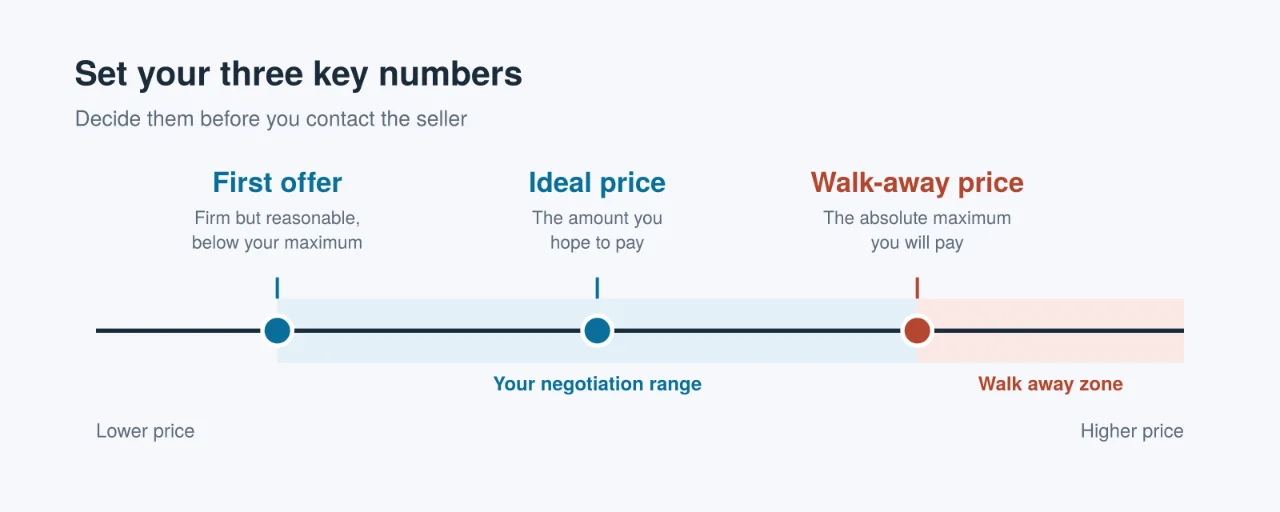
Write down three numbers before you contact anyone:
- Ideal price: the amount you hope to pay.
- Walk-away price: the absolute maximum you will pay.
- First offer: a firm but reasonable opening number, typically below your maximum.
Most domains are sold in US dollars, so convert your budget from UGX early. Remember to add escrow fees to your total cost.
Stick to the walk-away price. It is easy to break once the talks get exciting.
Prepare Alternatives
Never negotiate with only one option.
- Identify two or three backup domains, variations, or alternative extensions.
- Avoid emotional attachment to one name.
- Use alternatives to maintain negotiating confidence.
Confidence shows in your tone. A buyer with options asks calmer questions and accepts fewer bad terms.
Plan Non-Price Concessions
Money is not the only thing you can offer. Prepare a few sweeteners:
- Offer to cover escrow fees.
- Agree to a fast, clean transfer process.
- Provide a flexible closing timeline if helpful.
Use these to break deadlocks without raising the price unnecessarily.
Escrow fees are real money, so it helps to know them. Since 31 May 2024, Escrow.com charges 2.60% on transactions up to $5,000 with a $50 minimum. For $5,000 to $50,000, it charges 2.40% with a $130 minimum.
| Deal size | Escrow.com fee rate | Minimum fee |
|---|---|---|
| $0 – $5,000 | 2.60% | $50 |
| $5,000.01 – $50,000 | 2.40% | $130 |
Check the current rates on the provider’s site before you agree to pay them.
4) Make First Contact
Your first message sets the tone. Keep it simple.
Send a Professional, Neutral Message
A good first message is short and polite.
- Keep the message short and polite.
- Ask whether the domain is available for sale.
- Avoid revealing your brand, budget, urgency, or business plans.
- Do not say the domain is “perfect” for your project.
You are gathering information, not making a pitch. Let the seller name a price first when possible.
Establish Credibility
Sellers answer serious buyers faster.
- Mention that you intend to use escrow and a standard domain transfer process.
- Show that you understand the transaction and can close cleanly.
- Avoid pressure tactics or excessive enthusiasm.
This signals that you are low-risk and easy to work with.
Follow Up Strategically
Silence is common. It does not always mean no.
- Send one or two polite follow-ups if there is no response.
- Space follow-ups out rather than messaging daily.
- Remain calm and show that you have other options.
If you track several domains at once, a simple automation can help. We at Truehost offer N8n hosting, which you can use to set reminder workflows for follow-up dates.
5) Negotiate Offers and Counteroffers
Now the real conversation starts. Let data do the talking.
Anchor With a Data-Backed Offer
Your first offer should have reasons behind it.
- Support your first offer with comparable sales, keyword demand, extension value, and market trends.
- Avoid insultingly low offers on premium domains.
- Make the offer firm, reasonable, and easy to respond to.
Use real numbers. The market data shows how wide the range is. In the first half of 2025, reported sales totalled about 93,100 deals at an average of $1,311, yet one-word premium names sell for far more.
An offer that cites recent sales is harder to dismiss.
Handle High Counteroffers
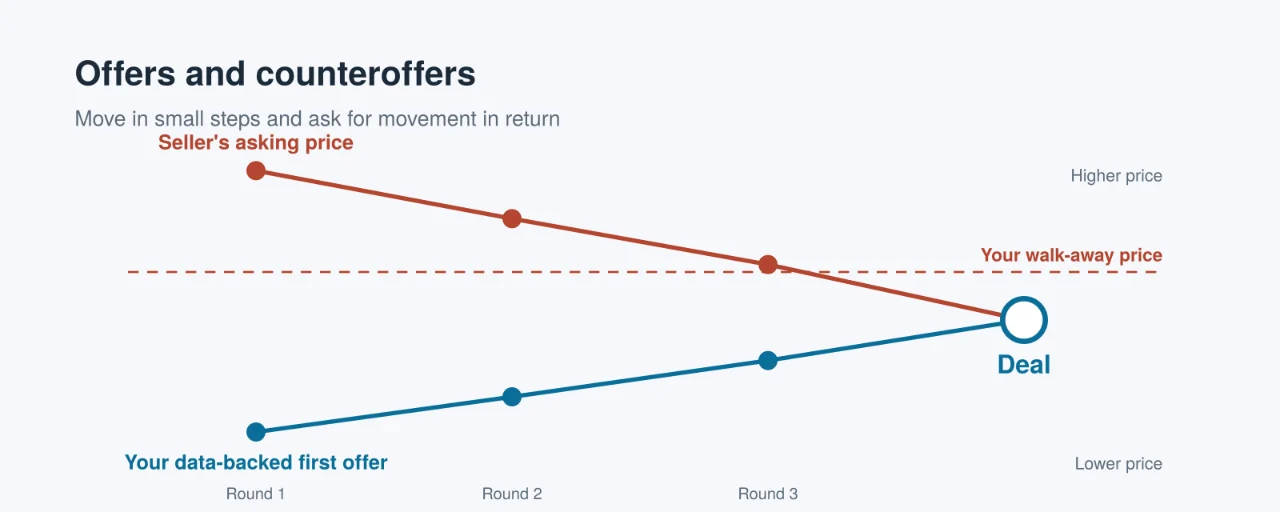
Expect a high number. Many sellers open high on purpose.
- Do not react emotionally to a high asking price.
- Ask the seller to explain their valuation.
- Restate your budget range and move in small, measured increments.
- Ask for reciprocal movement with every concession.
Small steps show discipline. Large jumps teach the seller that you will keep paying more.
Keep Emotion Out of the Deal
This is a business transaction.
- Treat the negotiation as a business transaction.
- Avoid showing urgency, excitement, or desperation.
- Signal calmly that you can look at alternatives if terms do not align.
The calmer buyer usually pays less.
6) Use Tactical Advantages
Small habits can protect your position.
Protect Sensitive Information
What the seller does not know cannot raise the price.
- Do not disclose funding, revenue plans, launch dates, or how important the domain is.
- Keep the conversation focused on the domain and market value.
- Prevent the seller from using your interest to justify a higher price.
Offer Small Sweeteners
Make it easy for the seller to say yes.
- Cover escrow costs.
- Commit to a quick transfer.
- Make the transaction simple and low-risk for the seller.
A low-risk deal is attractive to a busy owner.
Use a Cooling-Off Reset
Sometimes talks stall. A pause can restart them.
- Pause negotiations if the seller will not move.
- Return later with a clear final figure based on your limit.
- Set a respectful expiration point to avoid an open-ended negotiation.
A deadline keeps the process moving without pressure.
7) Consider a Domain Broker
Some deals are too big or too sensitive to handle alone.
When to Use One
A broker can help in these cases:
- For high-value or premium domains.
- When the owner is difficult to identify or reach.
- During rebrands, corporate acquisitions, or sensitive negotiations.
- When you want privacy and professional representation.
This is more important now that owner details are hidden by default.
What a Broker Provides
A good broker brings:
- Market knowledge and access to comparable sales data.
- Anonymous outreach and professional communication.
- Negotiation experience and stronger leverage.
- Help coordinating escrow and transfer.
Weigh Cost Against Value
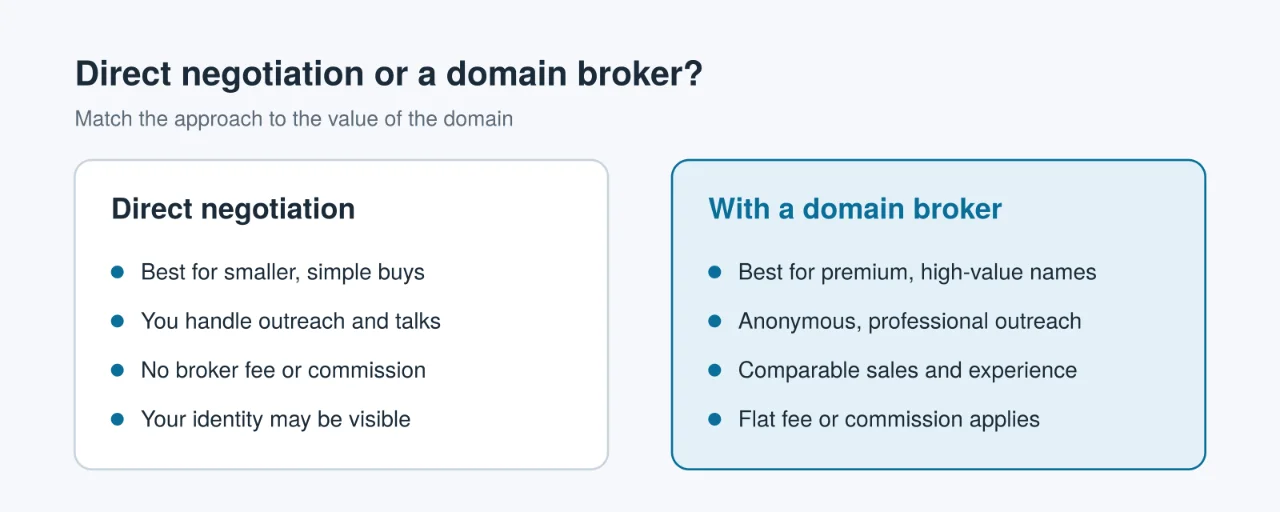
Brokers are not free.
- Brokers may charge a flat fee or commission.
- They are most valuable when the domain is essential and expensive.
- For smaller or straightforward purchases, direct negotiation may be enough.
For a sense of cost, Sedo’s broker service lists a 15% commission on the final sale price, charged only on success. Confirm the current terms with any broker before you sign.
8) Close the Deal Safely
A great price means little if the money disappears. Close the deal in a safe way.
Use Escrow for Every Sale
Escrow is not optional.
- Never send payment directly to the seller.
- Use a reputable escrow service to hold funds until the transfer is complete.
- Escrow protects both parties and creates a transaction record.
Fees are small compared with the risk. For example, a $2,000 domain now carries an escrow fee of $52 under the 2024 pricing.
Follow a Standard Closing Sequence
Follow the steps in order:
- Agree on the final price, domain, fees, and timeline in writing.
- Submit payment to escrow.
- Seller unlocks the domain and begins the registrar transfer.
- Buyer accepts the transfer and confirms control in their registrar account.
- Escrow releases payment once the transfer is verified.
Do not skip a step, even if the seller is in a hurry.
Complete Legal and Documentation Checks
Finish with a final review:
- Recheck trademarks before final payment.
- Confirm the domain is registered to your account and fully under your control.
- Save emails, agreements, transfer codes, receipts, and escrow records.
- Keep documentation for future ownership questions or resale.
Good records protect you years later.
Once the name is yours, you need somewhere to build on it. We at Truehost offer VPS, dedicated servers, OpenClaw hosting, AI Workers, and N8n hosting, so you can set up the project behind your new domain.
9) Know When to Walk Away
Walking away is part of the plan. It is also your strongest move.
Avoid Vanity Pricing
Some prices are built on hype, not data.
- Recognize unrealistic prices based on hype rather than market data.
- Do not chase a seller who repeatedly raises the price without justification.
- Stay disciplined about your maximum budget.
Go back to your comparable sales. If the asking price sits far above every recent comparable, ask the seller what justifies the gap.
Use Alternatives
Your backup list now pays off.
- Move to a backup domain, different extension, or brandable variation.
- Keep your brand strategy flexible.
- Avoid letting one unavailable name delay your project.
Many strong brands began with a less obvious name. Speed to launch is often more important than the ideal name.
You can register a good alternative with us.
Play the Long Game
Leave on good terms.
- Leave the conversation politely if no deal is possible.
- Some owners return with a lower price later.
- A calm exit preserves the possibility of a future agreement.
So What Next
Domain negotiation rewards patience and preparation. Here is what to remember:
- Successful domain negotiation combines research, patience, clear communication, and firm budget discipline.
- Protect yourself with escrow, written terms, and proper transfer documentation.
- Be ready to negotiate, but equally ready to walk away when the price exceeds real value.
- If negotiation does not lead to a fair deal, consider an alternative domain that still fits your brand and budget.
Your next step is simple. Set your three numbers and pick your backup names.
