You own a domain. Someone asks, ‘How much?’ What do you say?
A domain is worth what a real buyer will pay for it. A domain appraisal gives you an estimate, not a guarantee.
You need a number when you sell, negotiate, buy, or invest. A wrong number costs you money.
‘Domain worth’ means: three different numbers
- Appraised value: an algorithm’s or expert’s estimate.
- Asking price: what the owner wants.
- Sale price: what a buyer pays. This is the only number that counts.
Who is buying
- End-user buyers are businesses that need the name for their brand. They pay the most.
- Investors buy to resell. They pay a fraction of the retail value.
The same domain can have very different values, depending on which buyer you talk to.
Reality check: most domains sell for far less than owners expect. Of about 145,000 sales NameBio tracked in 2024, 115,700 fell between $100 and $1,000, averaging $306. Only 217 sales passed $50,000.
This guide will teach you:
- 8 factors that set a domain’s value
- 4 domain appraisal tools
- How to avoid appraisal scams
- What to do with your number
8 Factors That Determine a Domain’s Value
Each factor below covers what it is, what to check, and how it moves the price.
1) Comparable sales
- What it is: recent sales of similar domains (length, keyword, extension, industry).
- What to check: sales from the last 2–3 years. Old sales may not reflect today’s market.
- Why it counts: it is the closest thing to real market proof.
- Tip: compare like with like. Compare a .com with a .com, and a two-word name with a two-word name.
Good comp vs. weak comp: On February 22, 2024, landsale.com sold for $30,500 and farmsale.com for $7,900. Both are two-word .com names. That is a fair pair.
The same report shows 6666.tv at $15,700. That is a number-based .tv name. It tells you little about a .com keyword name.
2) Length, brandability and pronounceability
- Short names (under 15 characters) tend to be worth more. Shorter is usually better.
- Good names are easy to spell, say and remember.
- Value killers: hyphens, numbers, awkward spellings, hard-to-pronounce letter combinations.
- The “radio test”: say the name aloud. Can someone type it correctly?
Good vs. weak example: In NameBio’s February 10, 2024 report, the short pkq.com sold for $12,750. The hyphenated synonym-finder.com sold for $4,050.
This is one data point, not a rule.
3) Keywords and commercial intent
- Search volume: how many people search the keyword in the domain.
- CPC (cost per click): a high CPC signals buyers willing to pay.
- Buyer intent: words like ‘buy,’ ‘hire,’ ‘insurance’ and ‘loans’ signal money. Informational keywords signal less.
- Exact-match vs. partial-match: an exact-match keyword usually carries more value.
- Where to check: Google Keyword Planner, Semrush, Ahrefs.
For example, businessfunding.com sold for $44,000 at GoDaddy in February 2024. “Funding” is a money word.
4) Extension demand
- .com is usually the most valuable. It made up 74.4% of 2024 sales dollar volume.
- Other gTLDs (
.net,.org,.io,.ai) and newer extensions have their own demand. .ai domains passed $22 million in NameBio-reported sales in 2025. - Country-code extensions like .co.ug are valuable mainly to local buyers.
- Renewal cost: high renewal fees reduce investor interest.
- Trademark risk: a name that infringes a brand loses value and invites legal trouble.
Want a local extension? Search and register .co.ug, and more, with us at Truehost.
5) Age, history and backlinks
- Domain age: older domains can carry more trust, but age alone is not value.
- Backlink profile: quality beats quantity. Links from reputable sites help. Spammy links hurt.
- Past use: check for penalties, spam, blacklisting, or adult or gambling content.
- Where to check: Wayback Machine, Ahrefs, Semrush, and Google Search Console (if you own the domain).
6) Existing traffic
- Type-in traffic: people typing the domain directly.
- Referral and organic traffic: visits from existing links or rankings.
- Analytics proof: buyers pay more when traffic is documented and verifiable.
- Parked page vs. live site: a live site shows real use. It needs steady hosting, and a VPS is one way to get it.
7) Monetization and niche demand
- Monetization routes: parking ads, affiliate marketing, lead generation, direct business use.
- Niche demand: is the industry growing or shrinking?
- Market trends: emerging industries (AI, fintech, solar) lift domain values. One domain investor wrote that AI is now helping drive domain market gains.
- Buyer activity: are people in this niche actively buying names?
Building in a hot niche? We at Truehost offer VPS, OpenClaw hosting, AI Workers and N8n Hosting for AI projects.
8) Liquidity
- How quickly and easily could the domain sell?
- Broad appeal, such as common words and popular niches, means higher liquidity.
- Narrow or very specific names can be valuable, but only to a small buyer pool.
- Why it counts: a high valuation with no buyers is not real value.
The Best Domain Appraisal Tools
No single tool gives the truth. Each one shows a different slice.
a) GoDaddy Domain Appraisals (Free and Paid Tiers)
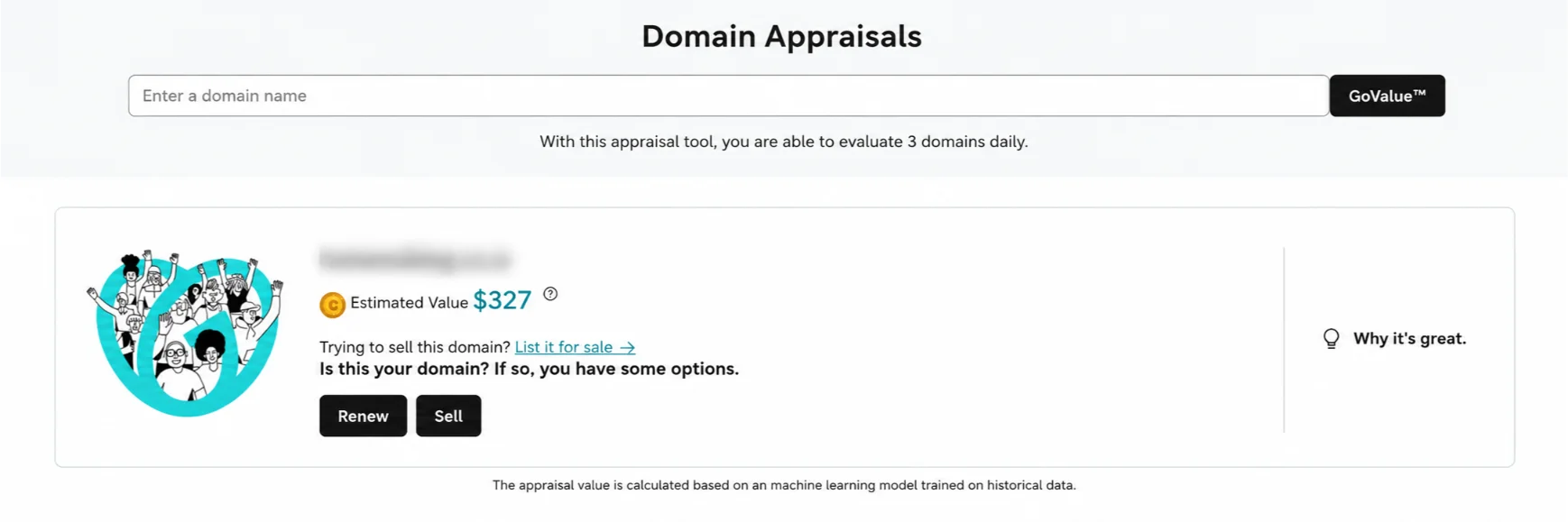
- How it works: machine learning trained on 20+ years of sales data.
- What it factors in: comparable sales, keyword value, extension and length.
- What you get: an estimated value, similar domains, and comparable domains sold.
- How to use it: enter the domain, review the estimate, then click through the comparable sales.
- Strengths: free 3 domain evaluations daily, instant, huge database.
- Limits: it can’t judge brandability, market timing or emerging trends. It also struggles with newer extensions like
.aiand.io. - Best for: a quick baseline.
b) EstiBot (Free and Paid Tiers)
- How it works: automated appraisal that weighs the name itself (such as length and extension) plus outside data like search volume.
- Scale: it is used for about 2 million valuations per day.
- Strengths: high volume, data-heavy, good for bulk checks.
- Limits: free use is capped per day, and paid plans add more lookups and tools. Check EstiBot’s site for current limits. Also, one domain expert finds it weak on made-up brandable names.
- Best for: checking many domains quickly, or a second opinion on your baseline.
c) NameBio (Free for Research)
- What it is: a database of more than $1 billion in historical domain sales.
- How to use it: filter by keyword, length, extension and date range.
- Context: the 2024 Top 100 average sale was about $457,648, with a median of about $142,131. NameBio recorded about 190,300 sales worth over $244 million in 2025.
- Strengths: it shows real transactions, not estimates.
- Limits: it is a research tool, not an appraiser. You interpret the data yourself.
- Best for: grounding every estimate in real prices.
d) Sedo Professional Appraisal (Paid, $99 per domain)
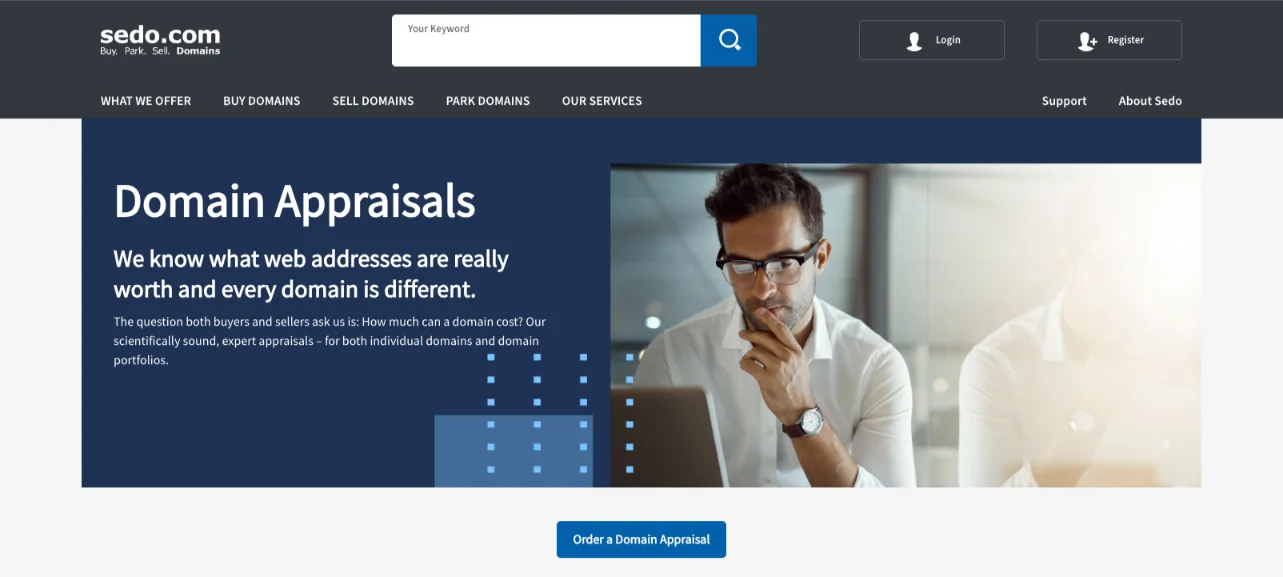
- Turnaround: within 5 business days.
- What it reviews: 10 factors, including search engine suitability, advertising effectiveness and selling prospects.
- Strengths: a human specialist reviews the name. Sedo says it holds the world’s largest database of domain transactions, which helps with international and country-code domains.
- Limits: it costs money. The report covers the domain only, not the website or business behind it. It is still an opinion.
- Best for: higher-value domains or ccTLDs.
How to Combine the Tools
Use them as a team, in this order:
- Run the domain through GoDaddy and EstiBot for baseline ranges.
- Search NameBio for comparable sales.
- Check keyword data and backlinks.
- Pay for a professional appraisal only if the name looks high-value.
- Treat the result as a range, not a single number.
| Tool | Cost | Best use |
|---|---|---|
| GoDaddy | Free | Quick baseline |
| EstiBot | Free and paid | Bulk checks, second opinion |
| NameBio | Free for research | Real comparable sales |
| Sedo | $99 per domain | High-value names, ccTLDs |
How to Spot Domain Appraisal Scams
The pattern: you get an attractive, unsolicited offer. The ‘buyer’ says you must buy a specific appraisal first. Then they disappear. The buyer vanishes after you pay the fee.
The appraisal often costs $50 or more, and the sender may own the appraisal service.
Things to Watch out For
- Urgency or pressure to act fast.
- Insistence on one particular appraisal or escrow service.
- An offer far above comparable sales.
- A buyer who never negotiates or asks about the domain.
Rule of thumb: a serious buyer already knows what the name is worth to them.
How to protect yourself
- Research comps yourself on NameBio.
- Use an established marketplace, or an escrow service you choose.
- Never share the EPP/auth code until payment is fully secured. A registrar creates this code to identify the holder and prevent unauthorized transfers, according to ICANN.
What to Do Once You Have a Number
You have three paths.
Sell
- Use marketplaces, brokers, or direct outreach to likely end-users.
- Set an asking price above your target. Buyers negotiate.
- Track your outreach in a simple workflow. Our N8n Hosting and AI Workers can help with that.
Hold
- Weigh the annual renewal cost against realistic resale potential.
- Remember that most sales are small, as the data above shows.
Build
- Use the domain for your own site or project.
- Start on a VPS, and move to a dedicated server if traffic grows.
Ready to build? Register your domain and get hosting with us at Truehost.
The Bottom Line on Domain Value
- Combine automated tools, real sales data and the qualitative factors.
- Treat any domain appraisal as a rough guide, not a guaranteed price.
- Higher-value names usually benefit from a professional appraisal and targeted marketing.
Your next step is simple. Run your domain through two free tools, then check NameBio comps.
Need a stronger domain for your own project? Search for yours with us at Truehost.
How to Find Out What a Domain Is Worth FAQs
How much is my domain worth?
It is worth what a real buyer will pay. Run free tools for a range, then check NameBio sales for similar names.
Are free domain appraisal tools accurate?
They give a starting point, not a final price. GoDaddy’s tool is reasonable for established .com names but weaker on brandable names. Treat any result as a second opinion.
Does domain age increase value?
Sometimes. Older domains can carry trust, but age alone does not create value. Traffic, links and demand count more.
Is .com always worth more than other extensions?
Usually, but not always. .com made up 74.4% of 2024 sales dollar volume, while .ai dollar volume rose 107%. A local extension like .co.ug can be worth more to a Ugandan buyer.
How long does it take to sell a domain?
No reliable average exists. It depends on price, niche and buyer pool. Broad, popular names usually sell faster.
Can I sell a domain I haven’t built a site on?
Yes. Buyers pay for the name itself. Sedo’s appraisal values the domain only, not any website on it. If you decide to build instead, our VPS plans serve Uganda.
