The cost of a dedicated server can range from around $50 to several hundred dollars per month, depending on the hardware, performance, and level of management you need. If you don’t understand what drives that price difference, you could end up paying for resources you don’t need or choosing a server that cannot handle your workload.
To make the right choice, you need to understand what your money covers, which additional costs to expect, and whether a dedicated server makes sense for your business.
Let’s look at what dedicated servers cost, what pushes prices up, and how to find the right option for your needs.
A dedicated server gives you an entire physical server instead of a share of one. That is why dedicated server pricing is higher than shared hosting or VPS hosting, and why the final bill depends on so many choices. The figures in this guide are approximate and illustrative, not quotes.
The dedicated server cost you actually pay depends on the provider, the specifications, the server location, the contract, and the services included.
What Are You Paying For?
- Server hardware (CPU, RAM, and storage): This is the largest part of the price. The CPU (processor) determines how quickly the server completes tasks, RAM (memory) determines how much work it can handle at once, and storage determines how much data you can keep and how fast it can be read. A website with a large database needs more of all three than a small brochure site.
- Hosting and data center infrastructure: This covers the building, power, cooling, and physical security that keep the server running. You do not buy these separately, but they are built into the monthly price.
- Bandwidth and network connectivity: This covers the data your server sends to visitors and the speed of its connection. Some plans include a fixed amount of data, and others advertise unmetered bandwidth with fair-use terms.
- Operating system and software licences: Open-source operating systems usually have no licence fee, while some commercial operating systems and control panels such as cPanel charge extra.
- Server management and technical support: The cost depends on whether the plan is managed or unmanaged, which the managed versus unmanaged section below explains.
- Security, monitoring, and backup services: These protect your data and alert you to problems. They can include an SSL certificate to encrypt traffic between your server and your visitors.
- Server setup and migration: This covers the work of configuring the machine and moving your website onto it, and some providers charge for it separately.
- Maintenance and additional services: This includes anything else you add, such as extra IP addresses or premium support.
Dedicated Server Cost
The price ranges below are approximate and illustrative, not universal prices. Actual prices depend on the provider, server specifications, location, contract length, and included services.
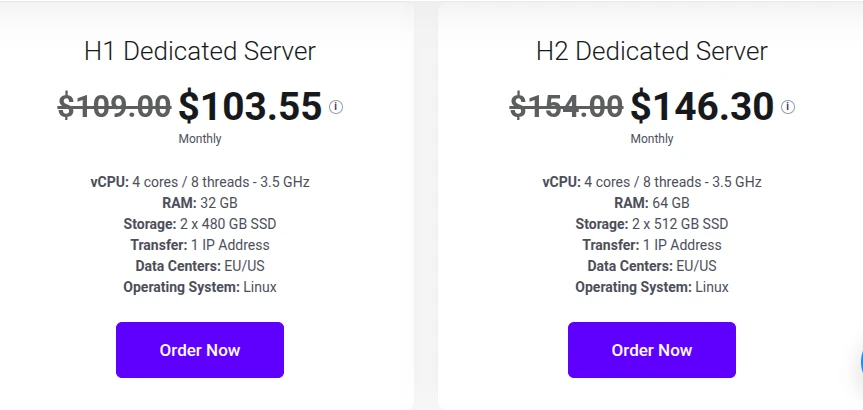
Entry-Level Dedicated Server: Around $50–$120 per Month
- Basic to moderate processing power, standard storage, and sufficient memory for smaller workloads.
- Who it’s for: small businesses, developers, growing websites, and businesses moving beyond shared or VPS hosting.
Entry-level servers suit workloads that have outgrown shared hosting or a small VPS but do not need heavy computing power. Examples include a business website with steady traffic, a development or testing environment, or a small application with a modest database. The hardware may be older or simpler than on higher tiers, which keeps the price lower. Over a year, this range works out to roughly $600 to $1,440 before add-ons.
Mid-Range Dedicated Server: Around $120–$300 per Month
- More CPU cores, additional RAM, faster storage, and greater capacity for demanding applications.
- Who it’s for: growing ecommerce stores, busy websites, databases, and businesses running multiple applications.
Mid-range servers suit workloads where performance affects revenue or daily operations. A growing online store that handles many simultaneous shoppers, a busy website with large media libraries, or a database that serves several applications are typical examples. More cores and memory let the server handle more tasks at the same time, and faster storage reduces delays when reading data. Over a year, this range works out to roughly $1,440 to $3,600 before add-ons.
High-Performance Dedicated Server: Around $300–$600+ per Month
- Powerful processors, larger memory capacity, fast NVMe storage, and configurations designed for resource-intensive workloads.
- Who it’s for: enterprises, large online stores, SaaS providers, and businesses with high computing demands.
High-performance servers suit workloads with heavy and constant demands, such as a large store with high traffic, a software-as-a-service platform that serves many customers, or data-processing tasks. NVMe is a faster type of storage interface than older SSD connections, and larger memory capacity helps applications that keep a lot of data in use at once. Prices can go well beyond the range shown here for specialised configurations. Over a year, this range starts at roughly $3,600 and rises from there before add-ons.
These annual figures only multiply the monthly ranges. Your real total will also include setup, licences, extra services, and any taxes, as the hidden costs section explains.
Compare tiers side by side. View Truehost Uganda dedicated server plans to see which configuration matches your workload.
Key Factors that Pushes the Price Up (And What Pulls It Down)
Cost drivers:
- Processor type, generation, and number of CPU cores
- RAM capacity and upgrade options
- Storage type, capacity, and redundancy
- Bandwidth limits and network speed
- Managed vs. unmanaged hosting
- Operating system and control panel licences
- Backup, security, and monitoring services
- Data center infrastructure and support requirements
Each of these changes the monthly bill in a practical way. A newer processor generation with more cores costs more than an older one, so a server built for a database-heavy store costs more than one built for a simple website. More RAM raises the price, and so do upgrade options that let you add memory later. Storage type matters too.
NVMe costs more than standard SSD, and redundancy, which keeps copies of your data across multiple drives (commonly through RAID), adds drives and therefore cost. Higher bandwidth limits and faster network speeds increase the price, and a managed plan costs more than an equivalent unmanaged one.
A commercial control panel adds a licence fee, while extra backup, security, and monitoring services each add to the total. Premium data centre infrastructure and stricter support requirements, such as faster response commitments, also raise the price.
Cost reducers:
- Choosing a server configuration that matches your actual workload
- Using open-source software where appropriate
- Choosing unmanaged hosting if you have the technical expertise
- Comparing monthly and annual billing options
- Avoiding unnecessary add-ons and premium services
- Starting with a suitable configuration and upgrading as your business grows
The most effective saving is not paying for resources you will not use. If your monitoring shows the server rarely uses more than a fraction of its memory, a smaller configuration may serve you equally well, and a VPS may meet a modest workload at a lower cost.
Open-source operating systems and control panels can remove licence fees, provided your team is comfortable with them. Unmanaged hosting lowers the hosting fee, but only if you or your team can handle the administration.
Compare monthly and annual billing, since longer commitments are sometimes priced lower but lock you in. Skip add-ons you do not need, and start with a suitable configuration instead of the largest one, as long as the provider lets you upgrade later.
Managed vs. Unmanaged Dedicated Servers
a) Unmanaged Dedicated Server
An unmanaged dedicated server gives you access to an entire physical server, but you handle most of the technical administration yourself.
This is usually the lower-cost option for businesses with experienced developers or system administrators. You may be responsible for software installation, security updates, monitoring, troubleshooting, and server maintenance.
It’s suitable if you have the technical skills to manage your server and want greater control over your hosting environment.
With an unmanaged server, the provider typically looks after the hardware, power, and network, while everything on the server is yours to maintain. Support is usually limited to hardware or network problems, so a software issue is your responsibility to fix. If you do not have someone with the skills in-house, the cost of hiring a server administrator or paying for ad-hoc help belongs in your budget.
b) Managed Dedicated Server
A managed dedicated server includes technical support and server administration from the hosting provider, depending on the package
Services may include server setup, updates, monitoring, security maintenance, and troubleshooting. It costs more than an equivalent unmanaged server, but it can save time and reduce the need to hire an in-house server administrator.
It’s suitable for businesses that need dedicated resources but prefer to focus on operations rather than server management.
Managed plans are not all the same. One provider may include monitoring and security updates, while another includes only basic setup and charges for the rest. Support arrangements also differ, including which channels are available and what the provider will and will not fix.
c) Which Option Offers Better Value?
The right choice depends on your technical capabilities and business needs. An unmanaged server may have a lower hosting fee, but administration takes time and expertise. A managed server costs more upfront but may offer better overall value if you need ongoing technical assistance.
The way to compare the two is total cost of ownership, which means the hosting fee plus the cost of the work needed to run the server. For an unmanaged server, add the salary or contractor cost of an administrator and the time you spend yourself. For a managed server, add any services the package leaves out. A business with a capable technical team may find unmanaged cheaper overall, while a business without one may find managed cheaper once the missing expertise is accounted for.
Dedicated Server vs. VPS vs. Cloud Hosting
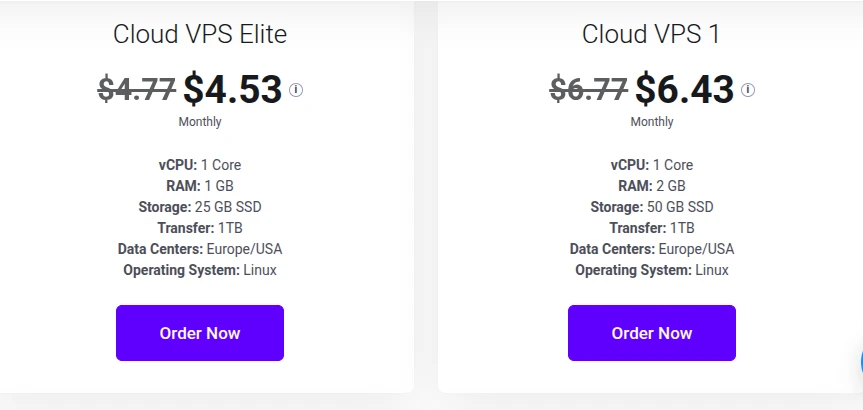
- VPS hosting: Generally has a lower starting cost and provides virtualized resources for websites and applications that don’t require an entire physical server.
- Cloud hosting: Can offer flexible scaling and usage-based pricing, depending on the provider and configuration.
- Dedicated server hosting: Gives you an entire physical server, making it suitable for workloads that require substantial resources, greater hardware control, or specific configurations.
The best option depends on your traffic, workload, budget, and technical requirements. A dedicated server may be unnecessary for a small website, while a resource-intensive application may benefit from its dedicated hardware.
The three differ in how the infrastructure is built. A VPS divides one physical server into virtual environments, each with its own allocated share of resources. Cloud hosting runs on a network of connected servers, so resources can be spread across machines. A dedicated server assigns one whole physical machine to a single customer, so no other customer shares its resources.
Scalability and pricing follow from that. A VPS is usually easy to resize within the limits of its host server, and cloud hosting is built for adjusting resources as demand changes, often with usage-based pricing.
A dedicated server has fixed hardware, so a major upgrade may mean moving to a different server, and it is usually billed at a fixed monthly rate.
None of these is always best. A steady, heavy workload may suit a dedicated server, while a workload with unpredictable spikes may suit cloud hosting, and a modest site may need nothing more than a VPS plan.
Hidden Costs to Budget For:
- Server setup and migration fees
- Operating system and control panel licences
- Additional backup storage
- Security tools and monitoring services
- Extra IP addresses, where charged
- Bandwidth overage charges
- Managed support and server administration
- Taxes and currency conversion fees
- Renewal price changes and contract commitments
Before choosing a plan, check which services are included in the advertised price. A low monthly fee may not represent the total cost if essential services are billed separately.
Look at the full cost of ownership instead of relying only on the advertised monthly price. For example, a plan that looks inexpensive may charge a setup fee, bill a control panel licence separately, and add overage charges if your traffic exceeds the included bandwidth.
If you are billed in a foreign currency, exchange rates and conversion fees can also change what you pay each month. Contract commitments and renewal pricing matter too, because the price after the first term may differ from the price you saw at signup. Ask the provider for a full quote that lists every recurring and one-time charge.
FAQs
How long does it take to set up a dedicated server?
It depends on the provider and the configuration. A standard configuration may be provisioned faster than a custom-built one, and a managed setup adds configuration time. Moving your website onto the server takes additional time. Ask the provider for an estimated setup time for the exact configuration you want, such as one of the dedicated server plans you are considering.
Do I need technical skills to use a dedicated server?
It depends on whether the server is managed or unmanaged. An unmanaged server requires skills in server administration, security, and troubleshooting. A managed server shifts much of that work to the provider, so you need far less technical knowledge. Check which services your plan includes.
Can I host multiple websites on one dedicated server?
Yes, as long as the server has enough resources for all of them. You control the server, so you can host several websites, and many people use a control panel such as cPanel to manage them. Consider the combined traffic and the isolation between websites, since a problem with one site can affect the others on the same server.
What happens if my dedicated server goes offline?
It depends on the cause. A hardware fault, a network problem, and a software error each have different fixes and recovery times. Check what support and response arrangements your provider offers, and keep current backups so you can restore your website if needed. No server is immune to downtime, so plan for it.
Can I move my existing website to a dedicated server?
Yes. Back up your website and database, set up the new server with the software your site needs, transfer your files and data, and test everything before changing your domain’s DNS settings. Keep your old hosting active until you have confirmed that the move worked. Some providers charge a migration fee, so ask before you order.
Does a dedicated server come with a domain name?
Not necessarily. A domain name and a dedicated server are separate services. Some providers sell both and may include or discount a domain with certain plans, but this varies, so check what your plan includes. You can also register a domain with Truehost or with another company and host it on a server from a different provider.
Ready to Power Your Business With a Dedicated Server?
When your website or application needs more resources and control, a dedicated server can help handle the workload and support your business as it grows.
Choose a server that meets your current needs without paying for resources you won’t use. This applies to busy websites, ecommerce stores, and applications that require a lot of computing power.
Before buying, compare dedicated server prices and check what each plan includes. Look out for extra charges and renewal rates so you know the full cost of hosting.
Ready to take the next step? Explore Truehost Uganda’s dedicated server hosting plans and find an option that works for your business.
