Finding the right domain name for your business, blog, or online project can be frustrating when the name you want is already registered. The domain may belong to an active website, show a parked page, or sit unused. A registered domain does not always mean you have to give up your preferred name.
A taken domain name is a domain that an individual, business, or organisation has already registered. You cannot register it as a new domain while the existing registration stays active, but you may be able to buy it through a private sale, marketplace, auction, or broker. The price and process depend on the owner’s willingness to sell, the domain’s value, and its registration status.
This article explains how to buy a domain that is already taken, where to find listings, how to approach the owner, what affects the price, and what to check before you pay.
Want to know if your preferred name is taken? Check domain availability with Truehost Uganda now and see its registration status in seconds.
How to Buy a Domain That Is Already Taken Step by Step
1) Confirm That the Domain Is Already Registered
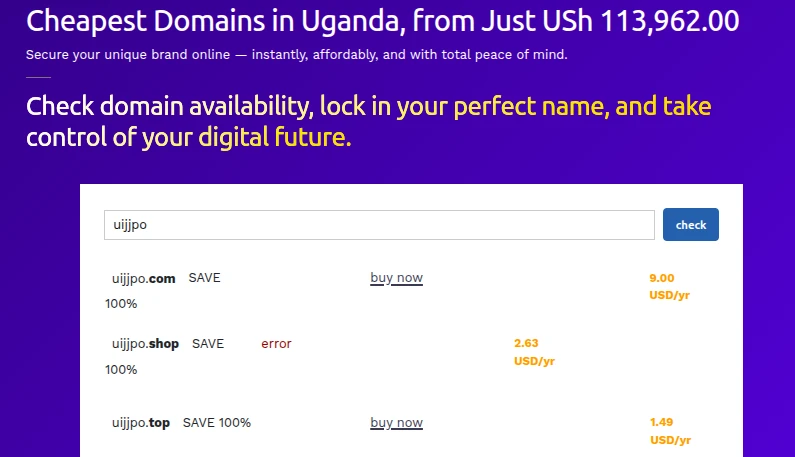
Start with a registrar’s search tool. Enter the exact name and extension, because brightfarm.ug and brightfarm.com are separate domains that may have different owners. You can search for your domain name on Truehost Uganda to see the result straight away.
A domain can be in one of three states. A registered domain has an active owner. An expired domain has passed its renewal date but may still be under the previous owner’s control during a grace or redemption period. An available domain can be registered by anyone. An inactive or empty website does not make a domain available. Many owners keep names for years without building anything on them.
To see more detail, use a WHOIS lookup or an RDAP service, such as ICANN Lookup. These tools show public registration data like the registrar, creation date, and expiry date. The exact fields shown vary by extension and registry.
2) Find the Current Domain Owner
Registration records are the first place to look, but they often fall short. Many owners use domain privacy services that replace personal details with a forwarding address. Even when a name appears, the person listed may not be the one authorised to negotiate a sale. A company’s domain may sit under an employee’s or a web designer’s name.
Other routes often work better:
- Visit the domain. It may show a business website, a parked page, or a “for sale” notice.
- Check for contact details. Look at contact pages, footers, and domain sales landing pages.
- Search marketplaces. The owner may already have listed the name.
- Consider a broker. A domain broker can approach the owner for you when contact details are hidden or hard to find.
3) Check Whether the Domain Is Listed for Sale
Search the established marketplaces for the exact name. A listing may show a fixed price, a make-offer option, or an active auction with a closing date. Read the seller’s terms, payment requirements, and transfer conditions before you commit.
If the name appears in more than one place, compare the listings. Prices, fees, and payment options can differ between platforms, and a lower asking price on one site may come with higher fees on another.
4) Research the Domain’s History and Value
Research tells you whether the name deserves your money. Check these points:
- Age and history. Find out how long the domain has been registered, and view old versions of its website through the Wayback Machine.
- Backlinks and search visibility. Look at which sites link to the domain and whether those links are relevant.
- Spam or misuse. Look for signs of spam, malware, or other abuse.
- Name quality. Consider spelling, length, extension, keyword relevance, and brand potential.
Automated valuation tools and third-party metrics are estimates, not guaranteed market values. Two tools can give very different figures for the same name. A domain appraisal can give you a starting reference, but your budget should rest on what the name is worth to your project.
5) Contact the Owner or Submit an Offer
Use the contact details on the website, marketplace, or broker listing. Introduce yourself professionally, say you are interested in the domain, and ask whether the owner is willing to sell and has a price in mind. Do not reveal your maximum budget.
A hypothetical first message might read: “Hello, I run a small agribusiness in Mbarara and I’m interested in brightfarm.co.ug. Is the domain available for sale, and if so, what price are you considering?” If the owner has not named a price and you want to make the first move, submit a reasonable opening offer based on your research. Keep all communication and agreed terms in writing.
6) Negotiate the Purchase Price
Compare the asking price with your estimated value for the domain, its relevance to your plans, and the alternatives available to you. Set a maximum amount before you start negotiating and keep to it.
Here is a hypothetical example. The owner asks UGX 2,500,000 and your ceiling is UGX 1,200,000. You offer UGX 700,000, the owner counters at UGX 1,800,000, and you respond at UGX 1,000,000. If the owner refuses to go below UGX 1,500,000, you have to decide whether to stay within your limit or walk away. These figures are invented for illustration, not market data.
Before you finish, agree on the final price, the payment method, and the transfer arrangements. Be ready to walk away if the price is unreasonable.
7) Complete the Payment Securely
Use a recognised marketplace or an escrow service where possible. With escrow, an independent third party holds your payment until the seller delivers the domain, and funds are released once the agreed conditions are met. The exact release terms depend on the service, so read them first.
Confirm that the seller actually controls the domain before you pay, for example by having them show access to the registrar account or change a verification setting, as the escrow provider directs. Avoid sending money through unverified channels, such as a personal mobile money number or bank account, based on informal promises. Keep receipts, transaction records, and written purchase agreements.
8) Transfer the Domain to Your Account
Confirm the transfer process with the seller or marketplace first. Two different processes exist. A registrar transfer moves the domain from one registrar to another and normally needs an authorisation code and approval from both sides. An account move shifts the domain between accounts at the same registrar, often called an account push.
If you do not have an account with the registrar that will manage the domain, create one. Obtain any required codes and approvals, then check that the domain appears under your account and that you control its registration settings. When you are ready to connect the domain to a website, update the nameservers and DNS records.
Where Can You Buy a Domain That Is Already Taken?
1) Domain Marketplaces
Marketplaces connect domain owners with buyers. You can browse listed names, compare seller prices, and choose between fixed-price listings and make-an-offer options. Sedo and Afternic are two established examples. Fees, listing features, and transaction terms differ from one marketplace to another, so check them before you buy.
2) Domain Auction Platforms
In an auction, interested buyers compete for a listed domain. This differs from a fixed-price purchase, where you pay the stated price and the name is yours. Auctions have minimum bids, deadlines, and conditions that vary by platform. GoDaddy Auctions and NameJet are examples. Research the domain before you place a bid, and set a limit in advance so competition does not push you over budget.
3) Domain Brokers
Brokers help buyers locate and negotiate for privately owned domains. They can be useful when the owner is hidden, hard to reach, or likely to respond better to an intermediary. A broker contacts the owner, handles the negotiation, and usually reports back with offers. Brokers charge commissions or service fees, and the terms differ, so check the fee structure, the broker’s reputation, and the service agreement before you sign.
4) Directly From the Current Owner
You can also buy straight from the registered owner. These sales often happen outside public marketplaces, so documentation matters. Write down the agreed price and the transfer conditions, and use an independent escrow service so neither side carries all the risk. Treat the sale as incomplete until the domain is confirmed in your account.
How Much Does It Cost to Buy a Domain That Is Already Taken?
A standard registration fee is a fixed price a registrar charges for an available name. An aftermarket price is whatever the seller asks and the buyer accepts, so it can be much higher or occasionally quite low. Some owners sell for modest amounts because they no longer need the name, while others ask premium prices for names they see as valuable.
Several factors influence the asking price:
- Name quality. Short names, memorable words, and commercially relevant keywords tend to attract more interest.
- Extension. A
.comoften has stronger buyer demand, while a country-code extension such as.ugmay suit a local audience. - Sale format. Fixed-price sales, private negotiations, and auctions can produce different results for the same name.
Add the extra costs on top of the price: marketplace commissions, broker fees, escrow charges, and transfer fees where they apply. After the purchase, you will also pay renewal fees each year. Set your budget before you enter negotiations so you do not decide under pressure.
What Should You Check Before Buying an Already Registered Domain?
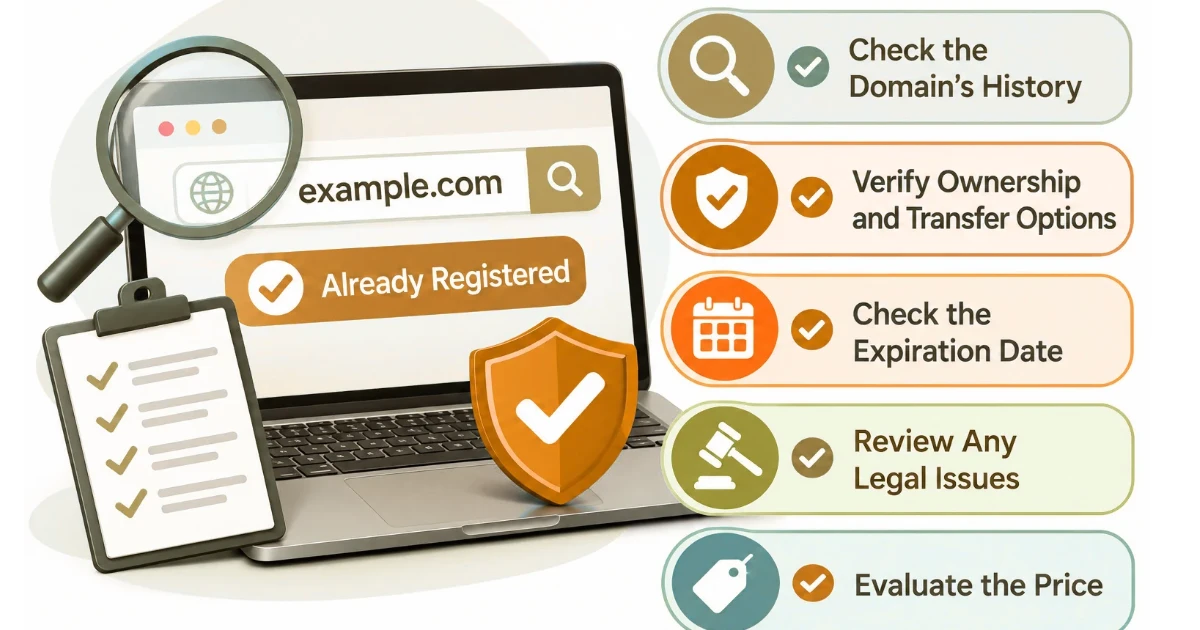
1) Domain History and Previous Use
Review the website’s previous content in historical archives. Check whether the domain was used for spam, misleading content, or suspicious activity, and look for signs of malware distribution. Ask whether its past use could affect your brand’s reputation, and whether the history suits the website you plan to build.
2) Trademark and Legal Issues
Check whether the domain contains a registered trademark. Search the WIPO Global Brand Database and local trademark records. Consider whether using the name could confuse customers who know an established brand. Buying a domain does not automatically give you the right to use a protected business name or trademark. Never buy a domain to impersonate another business. If ownership or trademark rights are unclear, seek legal advice.
3) Backlinks and Search Reputation
Review the quality and relevance of the sites linking to the domain, and flag suspicious or spam-related links. Where data is available, check for past search engine penalties or visibility problems. An existing backlink profile does not guarantee rankings or traffic, so treat it as a possible advantage, not a promise. Consider whether the domain’s online reputation fits your project.
4) Ownership and Transfer Restrictions
Confirm that the seller has the authority to transfer the domain. Check whether it is locked or subject to restrictions, since a domain lock can block transfers until the owner removes it. Review the registrar’s requirements and any waiting periods, and confirm the domain is not involved in an ownership dispute. Make sure you know the steps needed to gain full control of the registration.
5) Total Purchase and Renewal Costs
Add the purchase price to transaction fees, then check the annual renewal cost of the extension. Include brokerage or escrow charges. Ask whether the total fits your wider website budget, and avoid spending more on the name than it is worth to your project.
Common Mistakes to Avoid When Buying a Taken Domain
- Assuming that an inactive website means the domain is available for registration. Owners can hold unused names for years. Check the registration status instead of guessing.
- Paying a seller without confirming their ownership or authority to transfer the domain. Scammers list names they do not own. Verify control through the registrar or an escrow provider.
- Agreeing to a purchase price without researching the domain’s value. Without comparison, you may overpay. Look at similar names and set a ceiling first.
- Ignoring the domain’s previous use and online reputation. A spam history can follow a name. Review archived content before you commit.
- Overlooking trademark conflicts and potential legal disputes. A conflict can force you to give up the name after paying for it. Search trademark records early.
- Sending money through unsecured or unverified payment channels. Informal payments leave you with no protection if the seller disappears. Use escrow or a recognised marketplace.
- Assuming that existing traffic and backlinks will automatically benefit a new website. Traffic depends on content and purpose, not just the name. Treat old metrics with caution.
- Forgetting to account for renewal charges and transaction fees. The sale price is not the full cost. Calculate the total before you agree.
- Failing to agree on the transfer process before making payment. Disagreements about who does what can stall the sale. Settle the method and timeline in writing first.
- Treating the transaction as complete before confirming that the domain is under your control. Payment alone does not give you ownership. Check that the domain is in your account before you release final funds or move on.
FAQs
Can I Buy a Domain That Is Already Registered?
Yes, if its current owner is willing to sell. The sale can happen through a marketplace, auction platform, broker, or direct agreement with the owner.
Can I Buy a Domain Without Contacting the Owner Directly?
Yes. You can buy through a marketplace or auction platform where the seller has already listed the name. A broker can also contact the owner for you.
What Happens If the Domain Owner Does Not Respond?
Try another public contact method or use a broker. You can also consider alternative names instead of waiting for a reply that may never come.
Can I Buy an Expired Domain That Is Still Registered?
An expired domain may stay under the previous registrant’s control during a grace or redemption period, depending on the extension and registrar policies. It may later appear in an expired-domain auction or become available for new registration, but expiry does not automatically make it available for purchase.
Is Buying a Taken Domain Better Than Registering a New One?
It depends on your needs and budget. An existing domain may match your brand better, but it can cost far more than a new registration. If you can find a suitable alternative, a new domain may be the cheaper choice.
How Long Does It Take to Buy and Transfer a Domain?
The timeframe depends on the sale method, how quickly both sides agree, and the registrar’s transfer requirements. Some marketplace sales finish relatively quickly, while private negotiations and certain registrar transfers can take longer.
Ready to Buy the Domain Name You Want?
Buying a domain that is already taken is possible when the owner is willing to sell and the name can be transferred to you. The process involves identifying the owner, checking for sale listings, researching the domain’s history, agreeing on a price, and completing the transaction securely.
Before you commit, check that the domain suits your brand, look for legal or reputation concerns, and calculate the full cost of ownership. A memorable domain is valuable only if it fits your goals and budget.
If the name is unavailable or too expensive, register a suitable alternative rather than stretching your budget or choosing a name that could confuse customers with another brand. Once you secure the right domain, choose a reliable web hosting service and connect it to your website so you can start building your online presence.
