You have launched your online store, uploaded your products, and made sure everything looks good. There is just one problem: nobody is buying. Your website is live, but the orders are not coming in, and you are starting to wonder how other online businesses get their first customers.
Getting your first customers is one of the biggest challenges of starting an online store. People don’t know your brand yet, they may not trust your website, and they have no previous experience buying from you. The good news is that you don’t need a huge marketing budget or thousands of social media followers to make your first sales.
This article explains how to get your online store’s first customers using practical, affordable strategies, from reaching your existing network and promoting products on social media to building trust, attracting visitors through search engines, and encouraging your first buyers to return.
Marketers use the word conversion for the moment a visitor does what you want them to do, which is usually buying something. A store with few sales may have a traffic problem, because too few people visit, or a conversion problem, because visitors arrive but do not buy. The strategies below address both. Results will differ depending on your products, your audience, your competition, and how consistently you carry the work out, so treat each idea as something to test instead of a guaranteed outcome.
Want your store on solid foundations before you start promoting it? Explore Hosting Plans from Truehost Uganda
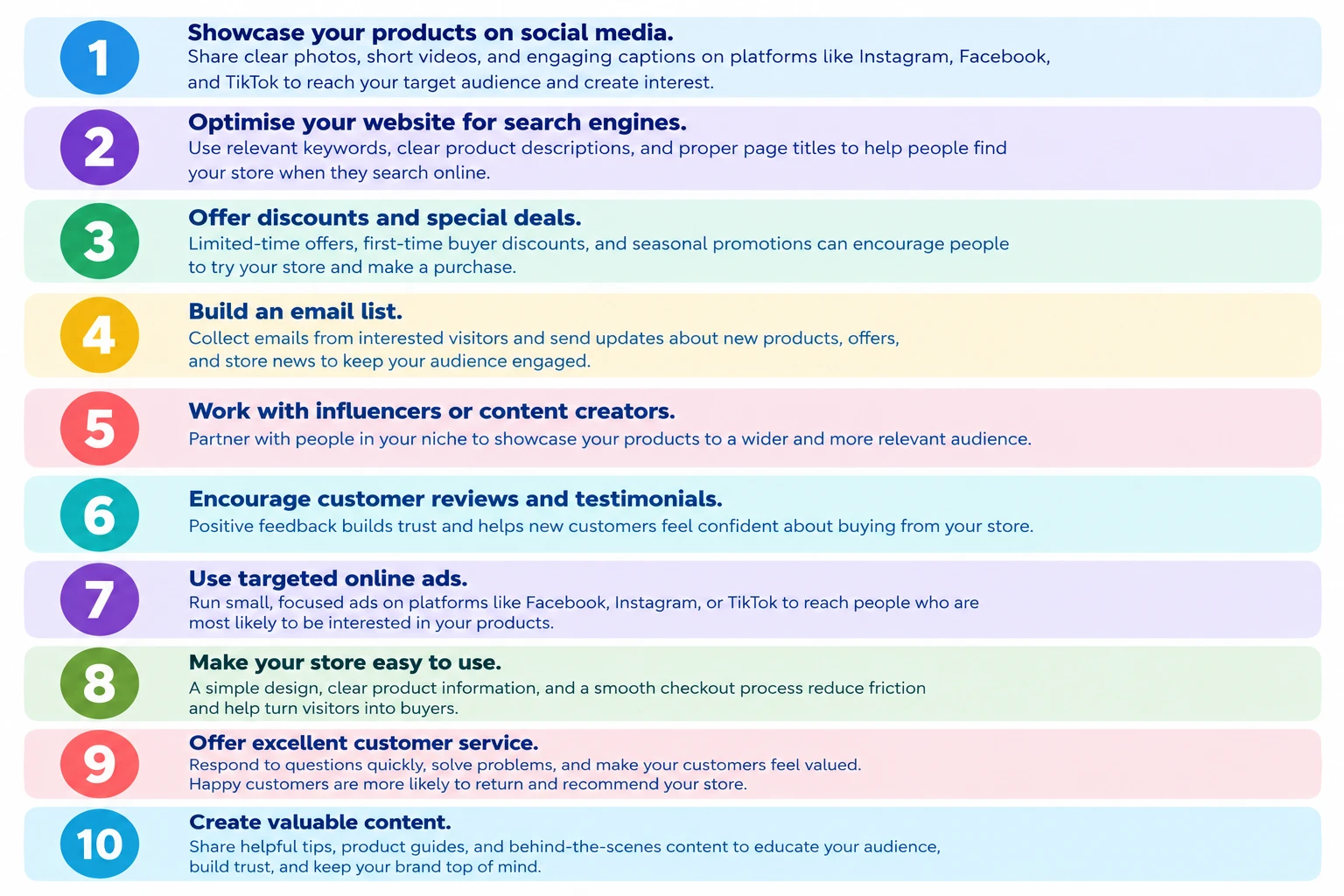
10 Ways to Attract Your First Online Store Customers
1) Start With People Who Already Know You
Your first customers do not necessarily have to come from strangers. Start by introducing your store to friends, family, colleagues, former customers, and professional contacts who may be interested in your products.
- Share your store launch through personal messages and social media.
- Explain what your store sells and who your products are designed for.
- Ask interested contacts to share your store with people who may need your products.
- Avoid pressuring people to buy simply because they know you.
Use your existing network to build initial awareness, but focus on reaching people who genuinely need what you sell.
2) Make Sure Your Online Store Is Ready to Convert Visitors
Before spending money on marketing, check if your website makes it easy for visitors to place an order.
- Use clear product descriptions and high-quality product images.
- Display prices, shipping fees, delivery timelines, and return policies.
- Make your checkout process simple and mobile-friendly.
- Offer convenient and secure payment options.
- Display genuine reviews, contact details, and clear business information.
- Test the complete buying process before promoting your store.
Marketing only helps if the store can turn attention into orders. Imagine a visitor who adds a product to the cart and then sees an unexpected delivery fee at the last step. Many will leave, and no amount of advertising fixes that. Walk through your store as a customer would. Place a test order on your phone, check that confirmation messages arrive, and ask a friend who has never seen the store to try buying something while you watch where they hesitate. Clear policies and visible contact details also reassure people who are unsure about buying from a new brand. MDN’s guide to responsive design explains how pages adapt to phone screens.
3) Promote Your Products on Social Media
Social media can help you reach potential customers without investing heavily in advertising.
- Choose platforms where your target customers already spend time.
- Post product demonstrations, tutorials, behind-the-scenes content, and customer use cases.
- Explain how your products solve specific problems.
- Answer questions and respond to comments promptly.
- Include a clear call to action that directs interested people to your store.
Avoid posting only product advertisements. Useful content gives people a reason to follow your business before they are ready to b2) Make Sure Your Online Store Is Ready to Convert Visitorsuy.
Concentrate on one or two platforms instead of spreading yourself thin. A store selling kitchen tools could post a short video showing how a gadget saves time, then a tutorial using it in a recipe, then a photo of how the products are packed. Each post should answer a question a buyer might have. Keep a steady schedule you can maintain, and put your store link where people can easily find it, such as your profile. A clear call to action, like asking people to message you with questions or visit the store, tells them what to do next.
4) Offer a Compelling First-Purchase Incentive
Give potential customers a reason to try your store for the first time.
Possible incentives include:
- A limited-time launch discount.
- Free delivery above a minimum order value.
- A bundle that offers better value than buying individual items.
- A small complimentary product with a qualifying purchase.
- A first-order coupon for new customers.
Choose an offer that attracts buyers without cutting too deeply into your profit margins. Make the terms clear and avoid creating false urgency.
An incentive lowers the risk of trying an unfamiliar store. Check the numbers before you promote it. As an illustration, if a product leaves you a 30 percent margin after costs, a 20 percent discount plus free delivery could leave you with little or nothing. A bundle or a small free item often protects your margin better than a deep discount. If you set a deadline, make it real. A launch offer that genuinely ends on a stated date is honest, while a countdown that resets every day is false urgency and damages trust.
5) Reach Out to Micro-Influencers and Relevant Creators
You do not need to work with celebrities to introduce your products to new audiences. Smaller creators with an engaged following may be a better fit for a new online store.
- Identify creators whose audiences match your target customers.
- Review their engagement and the relevance of their content.
- Offer product samples, paid collaborations, or affiliate commissions where appropriate.
- Provide a clear campaign brief and track results using unique links or discount codes.
- Disclose sponsored partnerships in line with applicable requirements.
Prioritise audience relevance and credibility over follower count alone.
A micro-influencer is a creator with a smaller, focused audience, and these audiences often trust their recommendations. An affiliate commission is a payment the creator earns for each sale that comes through their unique link or code, so you pay only when a sale happens. A small skincare store might send samples to a few creators who regularly review products for sensitive skin, rather than paying a large account whose followers have little interest in skincare. Read the comments on their posts to see how actively their audience engages with the content. Put the agreement in writing, including the content they will post and the posting dates. Clearly label sponsored posts and follow the advertising rules in your market.
6) Use WhatsApp and Other Direct Communication Channels
Direct communication can be particularly useful for businesses selling through social media or serving customers who prefer to ask questions before purchasing.
- Share product catalogues and store links through appropriate channels.
- Use WhatsApp Business features to organise products and respond to enquiries.
- Answer questions about sizes, availability, delivery, and payment.
- Follow up on enquiries when appropriate and with the person’s permission.
- Avoid sending unsolicited bulk promotional messages.
Make it easy for interested customers to move from asking questions to placing an order.
Many shoppers want quick answers before placing an order, such as product availability or delivery times. Having replies ready for common questions saves time and helps you respond clearly. Only message people who have requested information or agreed to receive updates, and give them an easy way to opt out. Sending bulk messages to people who have not signed up can annoy them, violate platform rules or privacy requirements, and get your number blocked. When a customer is ready to buy, share the product link so they can place their order easily.
7) Optimise Your Store for Search Engines
Search engine optimisation (SEO) can help potential customers discover your products when they search online.
- Use descriptive product titles and relevant keywords.
- Write unique product descriptions that explain benefits and features.
- Optimise category pages around the products you sell.
- Add useful content that answers customers’ common questions.
- Improve website speed, mobile usability, and navigation.
- Use descriptive image alt text and submit your sitemap where appropriate.
SEO takes time, so combine it with more immediate promotional strategies while your website builds visibility.
SEO means making your pages easier for search engines to understand and for people to find. Think about what a buyer would type when looking for your product. Instead of a vague title like “Classic Bag”, a title such as “Leather Laptop Bag for 15-inch Laptops” tells both shoppers and search engines what the page is about. Write your own product descriptions, because text copied from a supplier appears on many sites and does little to set your page apart. Alt text is a short description of an image that helps search engines and people using screen readers. A sitemap is a file listing your pages, and many store platforms generate one that you can submit through a search engine’s webmaster tools, as Google’s sitemap guide explains. Fast-loading, easy-to-navigate pages help both visitors and rankings, but results usually take months, not days.
8) List Your Products on Relevant Online Marketplaces
Marketplaces can introduce your products to shoppers who are already searching for items to buy.
- Research marketplaces that serve your target audience and location.
- Compare seller fees, fulfilment requirements, and competition.
- Create accurate listings with clear descriptions and images.
- Keep prices, inventory, and delivery information up to date.
- Direct customers to your own store where marketplace rules permit.
Consider marketplace sales an additional customer acquisition channel rather than relying on one platform alone.
On a marketplace, shoppers arrive ready to buy, which can mean quicker first sales than waiting for visitors to find your own site. The trade-offs are fees, competition from similar sellers, and rules you must follow. Compare the commission and any listing costs against your margins before you commit. Keep stock levels accurate, because overselling damages your seller rating. Read the marketplace’s policies on contacting customers and mentioning your own store, since many restrict this. Where it is allowed, include your brand name and a note about your store in packaging inserts or your seller profile so repeat buyers can find you directly. A memorable domain name also helps customers find your own store again.
9) Build Trust With Reviews and Social Proof
Customers are often cautious about buying from a store they have never used before. Genuine evidence that your business is reliable can help reduce that hesitation.
- Ask early customers for honest reviews after their purchases.
- Display authentic testimonials with permission.
- Share real product demonstrations and customer-submitted photos where authorised.
- Publish clear shipping, refund, and contact information.
- Respond professionally to customer questions and complaints.
Never fabricate reviews or present paid endorsements as independent customer experiences.
Social proof is evidence that other people have bought from you and been satisfied, and it helps new visitors feel safer. Ask for a review a few days after delivery, when the customer has had time to use the product, and make it easy by sending a direct link. Always ask permission before sharing a customer’s name, words, or photos. A few honest reviews, including a mildly critical one answered politely, look more believable than a page of perfect ratings. How you handle a complaint is visible to future buyers, so respond calmly and fix the problem where you can. Make sure your store uses HTTPS with an SSL certificate, since customers look for the secure padlock before paying.
10) Test Small, Targeted Paid Advertising Campaigns
Paid advertising can help you reach potential buyers faster, but spending money before understanding your audience can be expensive.
- Start with one platform that matches your target customers.
- Choose a specific product or product category to promote.
- Create ads that highlight a clear benefit and include a strong call to action.
- Set a budget you can afford to lose while testing.
- Track clicks, add-to-cart activity, purchases, and acquisition costs.
- Pause underperforming ads and improve your offer or targeting before increasing spending.
Make sure your website and checkout work properly before paying to send visitors to them.
Customer acquisition cost is the amount you spend on marketing divided by the number of new customers it brings. If a campaign costs more per customer than the profit on that customer’s order, you are losing money. Test with one product that you already know people like, such as a best-seller among your first buyers, and run a small campaign for a short period. Compare results across a couple of different ad messages. Increase spending only when the numbers show that the ads pay for themselves, and keep reviewing them, since results can change over time. If ads bring more visitors than your current plan can handle, VPS hosting is one option to compare.
Common Mistakes to Avoid When Looking for Your First Customers
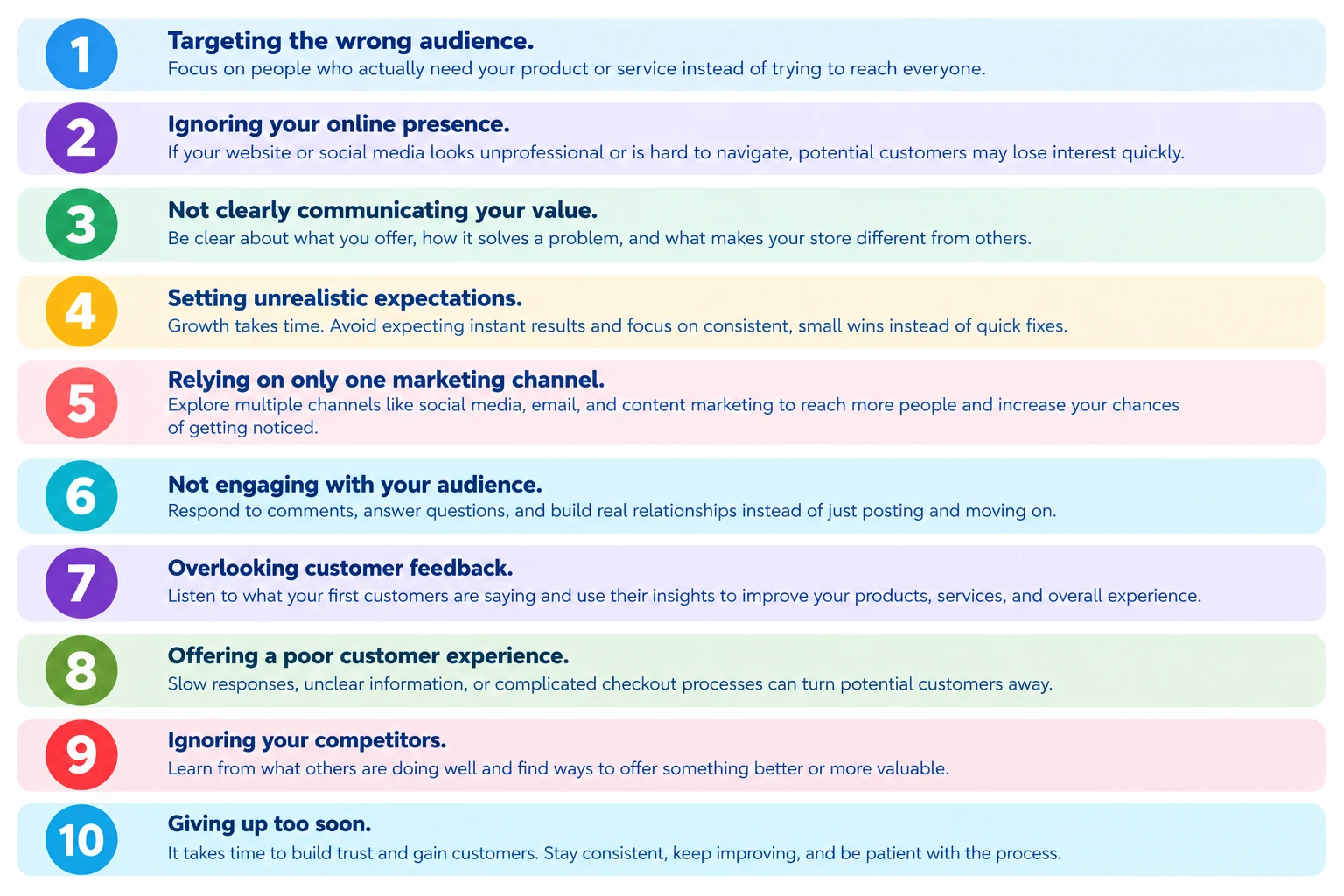
- Waiting for customers to discover your store without promoting it.
- Trying to market to everyone instead of defining a target audience.
- Spending heavily on advertising before testing your offer.
- Offering discounts that leave little or no profit.
- Ignoring customer questions and messages.
- Neglecting mobile users and checkout problems.
- Depending entirely on one social media platform.
- Expecting SEO to generate immediate results.
- Buying fake followers or reviews instead of building genuine trust.
A new store is not found on its own, so decide on a few promotion activities each week and stick to them. Defining a target audience, such as new parents or home bakers, helps you write messages that speak to someone in particular, and generic messages tend to reach no one. Test your offer with a small budget before scaling, and work out profit on each sale so discounts do not erase it. Reply to questions quickly, since a slow answer often loses the sale, and check your store on a phone, where many shoppers browse and pay (web.dev’s performance course covers page speed). Spread your efforts across more than one channel so a change on one platform does not cut off your customers. Treat SEO as a long-term investment alongside faster channels, and build trust with real customers, because fake followers and reviews can get accounts penalised and cost you credibility when customers notice.
FAQs
How Long Does It Take to Get Your First Online Store Customer?
There is no fixed timeline. Some stores make a first sale within days, often through friends, family, or direct messages, while others take weeks or longer. It depends on your product, your audience, the competition, and how much effort you put into promotion. Quicker channels, such as your network and direct messaging, tend to produce results sooner than SEO. Track early signals such as visits, enquiries, and items added to carts, which show if you are moving in the right direction.
How Can I Get My First Customers Without Spending Money on Ads?
Start with your network and share the store through personal messages. Post useful content on one or two social platforms, use WhatsApp for enquiries with permission, list products on a relevant marketplace, and work on basic SEO. You can also offer samples to relevant creators or join local community groups where your customers gather. These methods cost little money but take time and consistent effort. Google Search Central offers free guidance on SEO basics.
How Much Should I Spend on Marketing a New Online Store?
There is no universal figure. Start with an amount you can afford to lose while you test, and keep enough money for running the business, such as stock, delivery, and hosting. Work out your profit per sale, then judge each campaign by how much it costs to win a customer compared with that profit. Increase spending only after you see results you can repeat.
Which Social Media Platform Is Best for Getting Online Store Customers?
It depends on your product and audience. Visual products often do well on image and video platforms, while products for professionals may suit professional networks, and many small sellers rely on messaging apps for direct sales. Look at where your target customers already spend time and where competitors get engagement. Start with one platform, learn what works, and then add others.
How Do I Get Customers to Trust a New Online Store?
Show them that your business is real and reliable. Publish clear shipping, refund, and contact information, use real product photos, and make sure your site uses secure checkout. A professional domain and business email address help, and so do genuine reviews and quick, polite responses to questions. Honest information and good service build trust faster than claims.
Ready to Get Your Online Store’s First Customers?
Getting your online store’s first customers does not require you to do everything at once. Start by reaching people who may already be interested in your products, make sure your website is ready to convert visitors, and choose a few marketing channels that suit your audience and budget.
Pay attention to what brings people to your store, what makes them hesitate, and what ultimately convinces them to buy. Use those insights to improve your products, messaging, and customer experience.
Your first sale may take time, but each genuine customer interaction gives you an opportunity to learn and build a stronger business.
Keep a simple record of what you try each week and what happens, so you can repeat what works and drop what does not. Measure results, ask customers for feedback, and keep improving your product pages and checkout as you learn.
Before investing heavily in marketing, make sure your online store has reliable hosting, a professional domain, secure checkout, and a smooth shopping experience. Then start promoting your products and testing the strategies that work best for your business.
